For step by step, no commentary go here>>>

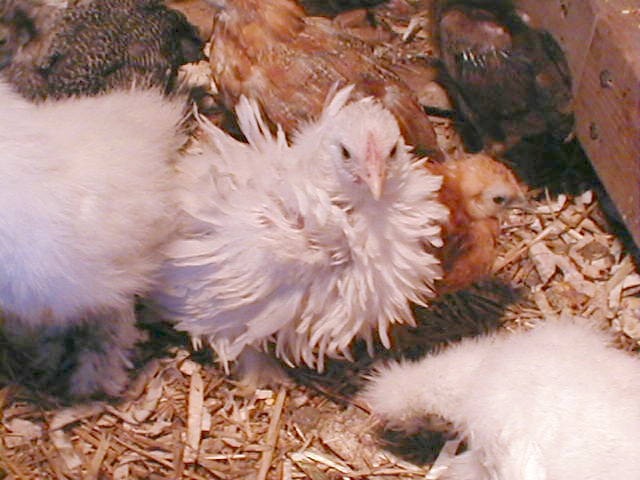
It started off innocently enough. Fresh organic farm eggs. We looked through the hatchery catalog, deciding on what chickens would be the best for our homestead. We ordered all females, yet we soon learned that
sexing a chick is not an exact science. We ended up with two roosters and four hens. Too many roosters for any small coop. The hens ran terrified from their advances. Hiding in the barn, in places where neither the roosters nor I could retrieve them. Soon one of the hens found a way to escape from the yard. Angered by the attitude of these amorous males, I marched angrily into the house. “Get me the gun! I am going to shoot them!” My husband of course laughed and said he would take care of them. And the chase began.
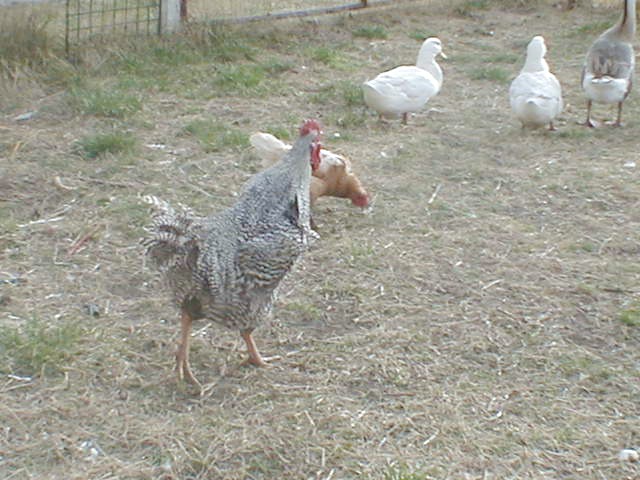
My husband and our oldest son {he is eight years old} went into the pen. Maybe our pen is too large. But we allow the goats, chickens and water fowl to roam together, eating bugs and homegrown grains and scraps. My two younger sons and I watched from the back deck as the other two ran around, trying desperately to capture the horny rooster. After a ten minute chase, and one goose bite, the rooster was snagged. {
I have seen a neighbor wandering around with a net on a long pole, I might need to invest in one} Walking up to us, my husband beamed a victorious smile, and suddenly became nostalgic. He asked if our oldest son wanted to see what it meant for someone to run around like a chicken with his head cut off. Of course he did. Even with my objections of, “the book says to hang it and slit the throat.” His excuse was, his father had shown him when he was a child. Now my fellow beginners, please, please listen to the books, and have the correct equipment when butchering your own chicken. Our mistakes didn’t end with the attempt to capture the rooster, as you will soon see.
I took the youngest son into the house. I for one did not want to see this. I had been a vegan for most my life, pregnancy turned me into the carnivore I am today. I know full well that packaged chicken does not grow on trees, but to see it first hand, not prerecorded, is a whole other issue. I raised these roosters from chicks. So I had some attachment issues and had to remind myself that organic meat was one of the reasons we bought them. From the false safety of my couch and closed window, I heard the thwack of the knife as it hit the butcher block.
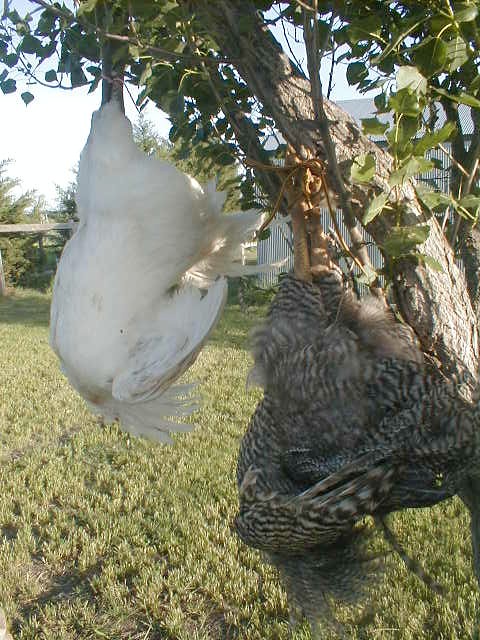
Mistake number one; we did not have the proper knife, my husband used the machete from out of the garage. Who knew that the necks of a rooster were that tough? The books didn’t say anything. Soon I see a grey and black rooster flying through the air. Its neck was broken and it died quickly, but the poor thing had defensive wounds on one wing. In long order {
neck still too tough} the bird was finally hung upside down to
bleed out. I went to check my boiling water and to call my mother.
As my husband and oldest son once again ran around the pen in an attempt to catch rooster number two, my mother informed me of the gullet.
Gullet? What!?! Why!?! Homesteading book numbers 1-5 say nothing of a gullet, and my anatomy of a chicken book had gone missing. My mother wasn’t clear on it, just that her mother had cleaned it out.
But the book mom! Thwack! They caught rooster number two and it now hung upside down from a tree as I frantically searched my books to find information on this gullet. Still clueless, I walked outside to a very proud husband, and a son mumbling “huh, so that’s what it looks like?” I am panicked. “There is this thing called the gullet, we have to remove it whole, or it will stink.” Of course I have heard of a gullet. I knew what it did, but where it was and how to remove it was beyond me. {
Can I just remind you that this is my first time?} My husband tells me to call his father, he will know. The call goes out, and I am told to cut around the base of the neck and pull the skin back, the gullet will be obvious {
um . . . ok}.
Back inside I have a twenty-gallon pot of boiling water. The book says that once it starts boiling, that the time it takes you to move it out to the bird, it will be cooled off enough to use.
Mistake number two, the pot isn’t big enough. I am standing with the rooster in my hand looking from pot to bird. How will this fit? The books only say a big pot. If twenty gallons isn’t big enough, then what? My husband reassures me that it will be fine and makes a joke about being so timid. I point out that I am a product of middle class suburbia. As if that justifies things. Firmly grasping the rooster, I push it down into the scalding water, and as the books says, I swished it around by the feet for 30 seconds. It stunk! The book never mentioned the smell that came with this. It was overwhelming, nausea inducing, longest thirty seconds I have ever had. Gagging, I handed the bird over to my husband and bravely asked for the other one. The second one was either cleaner or I had grown use to the smell, either way the book would not explain it to me.

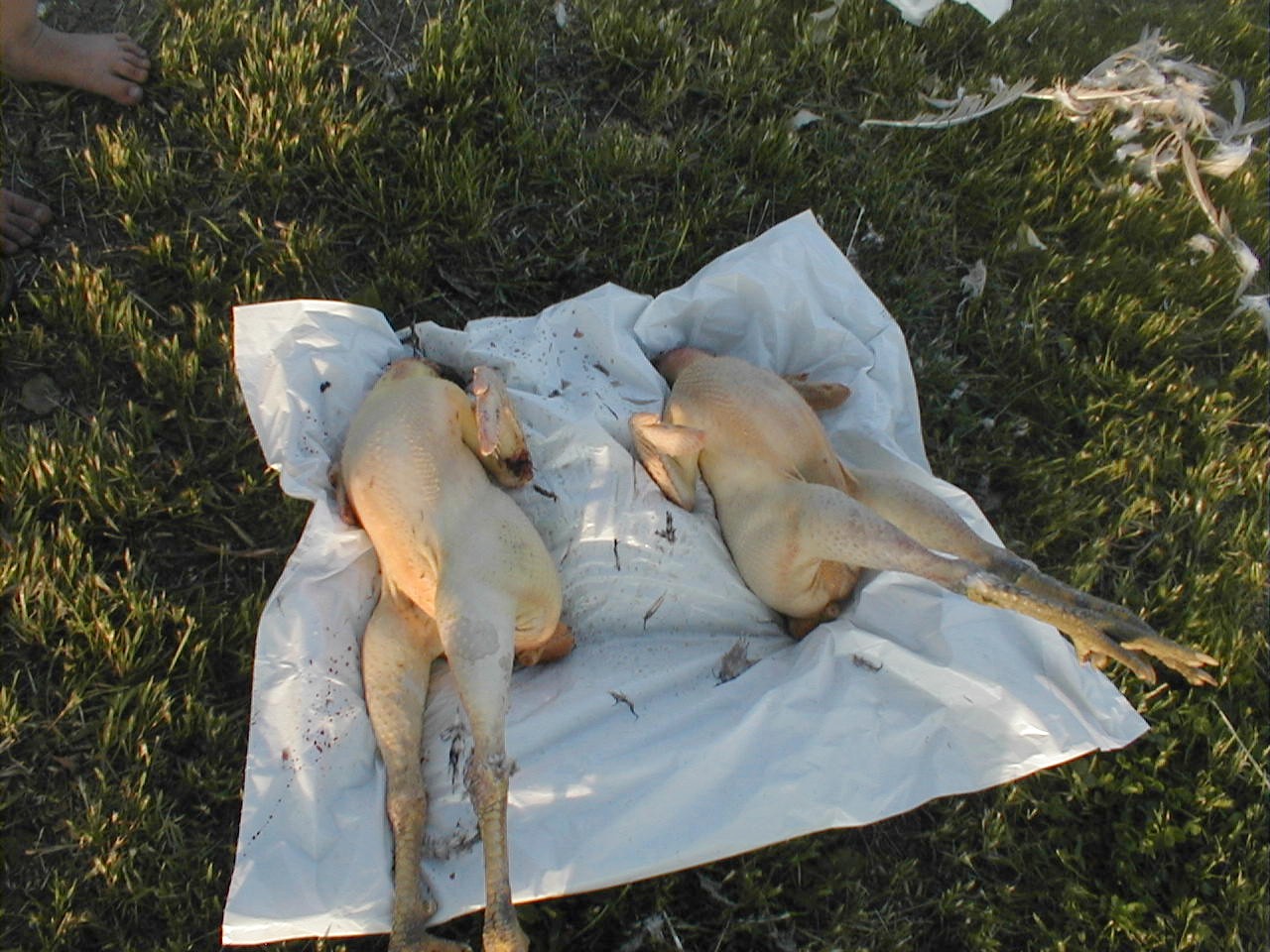
Time to remove the feathers. We place the birds on top of garbage bags. My husband with one, and me, the other. My bird had not scalded long enough {
maybe, the book just says hard, not how hard} for the feathers on the wing {
once again the books said to start with the wing and tail feathers, and the rest will come off as a sheet} was a little hard to remove. I did manage, and soon my bird was naked and my fingers were covered in soft sticky feathers. None of the books explained how one might keep that from happening. We made jokes about rubber chickens and my son posed with them for a picture. I know, silly, but we will always remember our first time.
The books tell us to start with its feet. My husband being the expert on human anatomy that he is, explains to his silly wife and his adoring boys how tendons work.
My mistake number three; marrying a know-it-all. As we had discussed in the past, I was the one that would be cleaning the birds. I followed the instructions in the book, and had the feet ready for removal. It was my husband that told me how to cut the tendons. The books didn’t say it, but it makes sense to me. Bend the foot down as far has capable, exposing as much tendon as possible before cutting it at an angle. Before long, my three sweet boys were torturing each other by pulling on the tendons and closing the rooster's toes around each other’s fingers.

The book says nothing about removing the gullet, so I am on my own there. I cut around the base of the neck as was told via the phone.
Mistake number four; not finding out which direction to pull the skin before doing so. There are two separate tubes. One was the throat. The other was full of scratch. But the father-in-law says it looks like a sack, not a tube! Do we remove that? My hands are bloody, another fact that the books didn’t seem fit to mention. As read by me, when you hang the bird upside down the carcass is now void of blood. Poor novice me. My husband dials the number and holds the phone to my ear. He grows tired of this within a few seconds, and removed his shirt so that I may hold the phone myself. My mother-in-law answers the phone and relays the discovery of a tube and not a sack to my father-in-law, whose own father is in town. I can hear them yelling at the phone about what kind of chicken did you buy? And to pull the tube out through the beak.
Mistake number five; Involving the in-laws. While I listened to their suggestions and jokes, my husband began cutting the skin down the breast, and lo and behold, the gullet! Now why couldn’t they have just said it was in the breast area? Carefully we removed the gullet, remembering my mother saying if we broke it, it would stink. Once that was removed, we could go back to following what the book said.
“To remove the gut, you must cut around the vent in a circular and funnel type fashion” Good detailed advice, isn’t it? One thing not mentioned was how big the circle should be. I cut around the vent, maybe a little too close, for suddenly I hear my husband yelling at me, I had cut into the intestines. What? I don’t smell anything. We feel panicked now, we must hurry.
Mistake number six; panicking because my husband smells something. I tried to pull the vent out. “
Once the vent is cut, the gut is easily removed.” {
Um . . . ok?} I pull and pull, nothing moves, so I cut some more. I pull again. Frustrated I wiggle my finger into the rooster, between the gut and flesh. I wasn’t expecting it to be so warm inside. I hesitate to say that this made my job any easier. I rolled my finger around, loosening and detaching the insides, from the insides. That helped, and I could remove the gut easily. And looky here, I had not cut the gut, merely milked it.
Nummy . . .
Mistake number seven; not having the correct equipment, once again. The book says to use a pair of good poultry shears and cut along the spine, the chicken should then open up like a book.
Can I close that book now, please? My knife would not penetrate the spine, and I don’t have shears. But my husband does have tin snips, dull tin snips. Slowly, I kind of follow the spine, veering to the left just a tad. “Open like a book”? A branded new leather bound that has been super glued shut maybe. And there are these sharp pokey things that emerge from the spine. After prying the rooster open, my three wonderful boys come running back to see what a heart looks like. Oh the sweet bliss of curiosity. A chorus of “I know what that is” rang out around me. Of course their identification of organs was off. Each boy took turns holding them before feeding it to the dog. I know one should keep the giblets, but I only held onto the liver {
very good fried and dipped in mustard} A round of eeewww gross could be heard over that one.
Mistake number eight; starting too late in the day. Night had fallen by the time I got the first rooster washed and into the freezer. My husband, being the kind soul he is, started on the next one, until he cut his knuckle and I had to finish. Here we are at the gullet again, and guess what, it doesn’t stink if broken. It took us two hours, from cutting the feet to placing them into the freezer. Our goal {
jokingly of course} is now five minutes. We realize that we will need to do it again, as we do have another rooster and have hopes of hatching are own chicks.
Some may say poor rooster, but I say, see the money we save doing this ourselves, taste the difference for yourself, think of how much more healthy you will be by raising and dressing your own organic bird. The benefits out weighed my repulsion. I did have a flash of dizziness from the blood on my hands, but reminded myself that it was not mine, but a rooster that I had cared for so lovingly and who will allow my boys to grow up healthy and learn a respect for animals in a way that some people will never know.
I will let you know later how the canning goes.


 Time to remove the feathers. We place the birds on top of garbage bags. My husband with one, and me, the other. My bird had not scalded long enough {maybe, the book just says hard, not how hard} for the feathers on the wing {once again the books said to start with the wing and tail feathers, and the rest will come off as a sheet} was a little hard to remove. I did manage, and soon my bird was naked and my fingers were covered in soft sticky feathers. None of the books explained how one might keep that from happening. We made jokes about rubber chickens and my son posed with them for a picture. I know, silly, but we will always remember our first time.