From Robbyn
A second specific question for Phelan and all: I have very little experience running my own business. We had a corporation for a while, so I have a little exposure. I was wondering about if there is some tax advice (no, i'll not hold anybody liable) about having something considered even on a small scale an "official Farm." I mean, do you have to declare something a farm or ranchette? Does this require different tax considerations? Who do farmers ask for advice on such things? I see that in some places you have to have licenses to sell produce at a roadside stand or elsewhere...is there some advantage or disadvantage in being an "official farm" or can an individual just do it? Is it better to NOT be an "official farm" as far as not having to jump through government hoops and regulations?
A lot of questions, but we're in unfamiliar territory, and would like to be reading up...and learning from those who know already from experience.
To be honest, I have no clue. Laws will vary from State to State, as will the benefits of being a farm. You might want to check with the local extension office and your tax advisor on this. If you do not plan on doing any commercial growing or selling, I don't see any benefits to becoming a legal farm. But that is here, not your state. The only benefit my homestead would get is a tax break on feed.
Anyone else have an answer for this question?

Donate Now!

Buy a membership or koozies to help!
Saturday, January 05, 2008


Why a Donkey?
From Kelly
Phelan, You mentioned owning a donkey. I've noticed that other homesteaders also have donkeys and I have been curious to know what their practical purpose was on the farm. What are your reasons?
We will own a donkey this spring. We have a sheep named Donkey.
 Firefly is coming to us from Marina. He's a gorgeous thing. The reason we decided to get a donkey was primarily expense related reasons. A good work horse can cost in the multiple thousands, while a good work donkey will cost only in the hundreds. We wanted something that could be multi purposed, work and guard duty. And a standard sized donkey was the best we found. Llamas and the like are well used, we had thought of those, but we prefer not to deal with the spitting and the exotic animals laws that we have here in my county.
The most practical reason to have a donkey on your homestead is for guard duty. They will not put up with any predators that might wonder onto your land looking for an easy meal. Male donkey's (Jacks) can be very aggressive, killing dogs with on swift kick, and they do not back down. We will also train him to a cart, I have no shame taking him into town to go shopping, and train him to the plow. As long as you have land to graze, we feel a donkey is our best economical choice.
For the story on getting our donkey, check out this series from earlier last year, entitled, The Quest for the Demon Donkey. Scroll down to the end of comments for the links to the continuation.
Phelan, You mentioned owning a donkey. I've noticed that other homesteaders also have donkeys and I have been curious to know what their practical purpose was on the farm. What are your reasons?
We will own a donkey this spring. We have a sheep named Donkey.
 Firefly is coming to us from Marina. He's a gorgeous thing. The reason we decided to get a donkey was primarily expense related reasons. A good work horse can cost in the multiple thousands, while a good work donkey will cost only in the hundreds. We wanted something that could be multi purposed, work and guard duty. And a standard sized donkey was the best we found. Llamas and the like are well used, we had thought of those, but we prefer not to deal with the spitting and the exotic animals laws that we have here in my county.
The most practical reason to have a donkey on your homestead is for guard duty. They will not put up with any predators that might wonder onto your land looking for an easy meal. Male donkey's (Jacks) can be very aggressive, killing dogs with on swift kick, and they do not back down. We will also train him to a cart, I have no shame taking him into town to go shopping, and train him to the plow. As long as you have land to graze, we feel a donkey is our best economical choice.

For the story on getting our donkey, check out this series from earlier last year, entitled, The Quest for the Demon Donkey. Scroll down to the end of comments for the links to the continuation.
Friday, January 04, 2008
What is a Neophyte?
This seems to be a popular question among school kids and extension office workers.
Merriam-Websters definition of the word is;
Merriam-Websters definition of the word is;
- Pronunciation:
- \ˈnē-ə-ˌfīt\
- Function:
- noun
- Etymology:
- Middle English, from Late Latin neophytus, from Greek neophytos, from neophytos newly planted, newly converted, from ne- + phyein to bring forth —
- Date:
- 14th century
Q&A
From Robbyn
Hi Phelan :)
Oh I have loads of questions. One of them is if you knew THEN what you know NOW, and you were like my husband and myself, poised at the point where we ALMOST have some land, what would you be doing to prepare for starting out. We're trying to make some gradual lifestyle changes towards what we hope will be permanent. I'm wondering what you'd be focusing on as far as how to set up your first "homestead"...what things you wouldnt do at the outset...what things have proven invaluable...what you'd not waste time and money on in your initial excitement.
We don't anticipate being a large producer of anything or having a substantial income from our property when we get it...but we do want to substitute our present outgoing expenses with things that are self-sufficient and sustainable and can be done ourselves. And we're willing to work hard (we do anyway in other ways right now). Anything advice-wise, anything from what kind of structure you'd build to live in, if you'd begin with focus on the garden and then add animals, etc...what basic tools (I know you did a series) would you begin with...etc
We certainly have ideas on all these things, but they are just that...and arent proven. We'd like to know what mistakes you'd NEVER want to repeat and what things you would ALWAYS be glad you've done.
:) Thanks! As if you can fit all that into one post?? hee hee
I think the question is a post itself. HA!
Lets start with the land hunting. If I knew that I would be homesteading, we would have done things a little different. First we would sit down and make a list of the things that we would like to have ( a wood lot, a pond and/or creek, etc. . .) Once we found a land that was close to our needs we would ask for some info like if the top soil had ever been stripped, how high is the water table, the quality of the water, what animals had been there, what crops if any had been farmed there, what were/are the building codes for the county, what are the animal restrictions, does a covenant come with the land? (this is besides the basic questions) If all the answers were correct for my needs then I would want to pay cash straight out, no debts.
Fencing and barns would be one of the first priorities after a house (if one wasn’t already on it) As for what type of house, that would be the Underground home that I have talked about here before.
Immediately I would place in a garden, before any animals. If you are not use to organic gardening, you should really try your hand at it before getting animals. A trained dog and a couple of cats for the house and barn. Then move on to the types of animals that we deemed “needed” to survive ( donkey, sheep, chickens, and cows are on my priority list. I love our goats, but won’t eat them)
Items for canning, and just about all the tools I have listed in the series are musts for me. I am sure there are some out there that I have yet to try, but the basics are the best. I would highly recommend an expensive pair of field scissors and knife. You will use that more then any other tool.
Some things I wouldn’t waste my money on are some of the so called homestead helpers. If it is made of plastic, don’t bother. Scrimp and save for the metal items. Also be aware of your seed purchases, sometimes you can go a little crazy with them. A good rotor tiller is also something I would go ahead and spend some money on, depending on the soil you can break the cheaper ones blades (fun fun) I would have purchased a small tractor as well (something I hope we can some day have)
You will need to work hard, and if you are like us with limit income, you will be unable to do everything you want. Start out slowly, and by all means talk to people. I know I have said it so many times, but telling people your plans will earn you their free junk. All my canning things I got for free. Look through papers, and garage sales as well as auctions, a lot of the items needed to homestead can be found cheaply in those places.
There are many thing I would never want to do again, like shocking myself, or butchering a bird for the first time. (But I will do it the 2nd time on) As for things I will always be glad to have done, simply pick a post. I am glad to have been able to do all the things, at least once, the good, the bad and the oh so very ugly.
You will make mistakes, many mistakes. And this is why I blog. Those homesteading books (and yes even Carla Emery’s) don’t tell you everything that can happen. We will do stupid things (Hey it sounded good at the time) we will fall, only to brush ourselves off and fall again. But if this is the life you truly wish to have, it is all worth it in the end.
Now Robbyn, talk a deep breath, and ask a more specific question, please, I feel like this answer of mine is no answer at all. (look to my sidebar, there is several drop down boxes, any of which might clarify some of my answers, like the housing) If we can take one subject at a time, I may be able to help more.
All weekend I will be answering questions.
Hi Phelan :)
Oh I have loads of questions. One of them is if you knew THEN what you know NOW, and you were like my husband and myself, poised at the point where we ALMOST have some land, what would you be doing to prepare for starting out. We're trying to make some gradual lifestyle changes towards what we hope will be permanent. I'm wondering what you'd be focusing on as far as how to set up your first "homestead"...what things you wouldnt do at the outset...what things have proven invaluable...what you'd not waste time and money on in your initial excitement.
We don't anticipate being a large producer of anything or having a substantial income from our property when we get it...but we do want to substitute our present outgoing expenses with things that are self-sufficient and sustainable and can be done ourselves. And we're willing to work hard (we do anyway in other ways right now). Anything advice-wise, anything from what kind of structure you'd build to live in, if you'd begin with focus on the garden and then add animals, etc...what basic tools (I know you did a series) would you begin with...etc
We certainly have ideas on all these things, but they are just that...and arent proven. We'd like to know what mistakes you'd NEVER want to repeat and what things you would ALWAYS be glad you've done.
:) Thanks! As if you can fit all that into one post?? hee hee
I think the question is a post itself. HA!
Lets start with the land hunting. If I knew that I would be homesteading, we would have done things a little different. First we would sit down and make a list of the things that we would like to have ( a wood lot, a pond and/or creek, etc. . .) Once we found a land that was close to our needs we would ask for some info like if the top soil had ever been stripped, how high is the water table, the quality of the water, what animals had been there, what crops if any had been farmed there, what were/are the building codes for the county, what are the animal restrictions, does a covenant come with the land? (this is besides the basic questions) If all the answers were correct for my needs then I would want to pay cash straight out, no debts.
Fencing and barns would be one of the first priorities after a house (if one wasn’t already on it) As for what type of house, that would be the Underground home that I have talked about here before.
Immediately I would place in a garden, before any animals. If you are not use to organic gardening, you should really try your hand at it before getting animals. A trained dog and a couple of cats for the house and barn. Then move on to the types of animals that we deemed “needed” to survive ( donkey, sheep, chickens, and cows are on my priority list. I love our goats, but won’t eat them)
Items for canning, and just about all the tools I have listed in the series are musts for me. I am sure there are some out there that I have yet to try, but the basics are the best. I would highly recommend an expensive pair of field scissors and knife. You will use that more then any other tool.
Some things I wouldn’t waste my money on are some of the so called homestead helpers. If it is made of plastic, don’t bother. Scrimp and save for the metal items. Also be aware of your seed purchases, sometimes you can go a little crazy with them. A good rotor tiller is also something I would go ahead and spend some money on, depending on the soil you can break the cheaper ones blades (fun fun) I would have purchased a small tractor as well (something I hope we can some day have)
You will need to work hard, and if you are like us with limit income, you will be unable to do everything you want. Start out slowly, and by all means talk to people. I know I have said it so many times, but telling people your plans will earn you their free junk. All my canning things I got for free. Look through papers, and garage sales as well as auctions, a lot of the items needed to homestead can be found cheaply in those places.
There are many thing I would never want to do again, like shocking myself, or butchering a bird for the first time. (But I will do it the 2nd time on) As for things I will always be glad to have done, simply pick a post. I am glad to have been able to do all the things, at least once, the good, the bad and the oh so very ugly.
You will make mistakes, many mistakes. And this is why I blog. Those homesteading books (and yes even Carla Emery’s) don’t tell you everything that can happen. We will do stupid things (Hey it sounded good at the time) we will fall, only to brush ourselves off and fall again. But if this is the life you truly wish to have, it is all worth it in the end.
Now Robbyn, talk a deep breath, and ask a more specific question, please, I feel like this answer of mine is no answer at all. (look to my sidebar, there is several drop down boxes, any of which might clarify some of my answers, like the housing) If we can take one subject at a time, I may be able to help more.
All weekend I will be answering questions.
Busy Busy Bee
The one thing that I like about winter is that I am not so busy. The bad thing about winter is that I am not so busy.
I thought that today and throughout the weekend we could play another round of Q&A.
This has been a hit and miss around here, so if you don't have any questions, that's fine. But if you do have a question please leave it, or email me.
Need me to expand or clarify something on a post? Have a handful of chestnuts you don't know what to do with, or just want to know a little more about the author, feel free to ask away.
I thought that today and throughout the weekend we could play another round of Q&A.
This has been a hit and miss around here, so if you don't have any questions, that's fine. But if you do have a question please leave it, or email me.
Need me to expand or clarify something on a post? Have a handful of chestnuts you don't know what to do with, or just want to know a little more about the author, feel free to ask away.
Thursday, January 03, 2008
I so Rule!
Seed Update, Day 3
As of 6am this morning, everything but the onions, peppers and a few of the tomatoes have sprouted. Much to our relief. We had feared that the Good Neighbor Peas wouldn't sprout as they have been in a fridge for the past 2 years. Hope you are reading good neighbor, looks like we have some success!
Yesterday I went across the way to another neighbors house. She is raising 3 of her grandchildren, and the youngest is wearing the size clothing that my youngest has just outgrown. I took along my seed catalogs. Her land is much more sandy then mine, and her pumpkins do very well. We sat and talked about gardening and her wanting to become more self sufficient. With the price of living on the rise and her and her husband raising children once again, she felt it was time to learn.
She asked that I help her and show her some things she can do. We discussed crop sharing, and canning, chickens and other livestock. She recently had her 2 pet ducks stolen, and is determined to try again.
She also purposed that we get some of the other woman in the area together and have me teach them how to cook things from scratch. Apparently she has already discussed this with some others and they would be interested in this. I guess I will be a teacher and lecturer of the neighborhood. Which isn't all that bad If something should happen, we should be able to rely on one another. We shall see, it is already starting off to be an interesting year. Can you imagine an entire neighborhood of Me's? ha!
My husband wants to take our oldest to Hunter Safety classes. I am all for it. Personally I think that all kids so take the course, even if they never plan to hunt. I have asked for a compound bow as a gift, at some point in the year. How far I have come over the years. I use to be so anti-meat, hunting and fishing were cruelty, and I wouldn't even work with leather or wear leather. Now look at me. I find it to be a fascinating evolution, something I wasn't truly aware was even happening.
As of 6am this morning, everything but the onions, peppers and a few of the tomatoes have sprouted. Much to our relief. We had feared that the Good Neighbor Peas wouldn't sprout as they have been in a fridge for the past 2 years. Hope you are reading good neighbor, looks like we have some success!
Yesterday I went across the way to another neighbors house. She is raising 3 of her grandchildren, and the youngest is wearing the size clothing that my youngest has just outgrown. I took along my seed catalogs. Her land is much more sandy then mine, and her pumpkins do very well. We sat and talked about gardening and her wanting to become more self sufficient. With the price of living on the rise and her and her husband raising children once again, she felt it was time to learn.
She asked that I help her and show her some things she can do. We discussed crop sharing, and canning, chickens and other livestock. She recently had her 2 pet ducks stolen, and is determined to try again.
She also purposed that we get some of the other woman in the area together and have me teach them how to cook things from scratch. Apparently she has already discussed this with some others and they would be interested in this. I guess I will be a teacher and lecturer of the neighborhood. Which isn't all that bad If something should happen, we should be able to rely on one another. We shall see, it is already starting off to be an interesting year. Can you imagine an entire neighborhood of Me's? ha!
My husband wants to take our oldest to Hunter Safety classes. I am all for it. Personally I think that all kids so take the course, even if they never plan to hunt. I have asked for a compound bow as a gift, at some point in the year. How far I have come over the years. I use to be so anti-meat, hunting and fishing were cruelty, and I wouldn't even work with leather or wear leather. Now look at me. I find it to be a fascinating evolution, something I wasn't truly aware was even happening.
Wednesday, January 02, 2008
Phelan's Box
A few of you asked about our seed box. The box is one of our tools as well as a repurposed item, (and to make Stephanie happy, it is made from scratch) Surprisingly enough, it is a relatively inexpensive item to make. Here is the run down.

You will need;
We have very little money into this box, most of the things acquired where given to us, or we had laying about.
3 1/2 sheets of plywood
We had 4 sheets of 3/8 plywood 6 feet tall given to us (one reason for the shape of the box) 1 for the front, 1 for the back and 1/2 for each side, and 1/2 for the top.
2x4s in the corners and across the top
You can use a variety of light sources or heat mats with low light water bed heater, just keep the air moving so you don't turn your box into an oven. We run 400 watts in ours using a grow light
1x material
reclaimed door hinges, screws
A reclaimed squirrel cage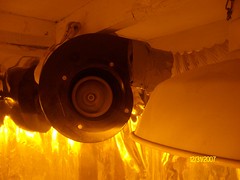 and dryer vent, and metal coffee can help vent out the heat so we don't scorch our plants. A small fan (was an osculating fan, but won't osculate anymore) that can be turned on to regulate any heating issues, and keeps the carbon dioxide levels up by exchange old air for new. The height helps with temp regulations as well.
Mylar or anything reflective is used on the walls and the doors (glossy white house paint works, and is the cheapest of all the materials that could be used unless you have stuff laying about that you could use). The reflective stuff is used for light refraction, keeps the light bouncing around the box, maximizing your lumins.
Drip trays are need for any condensation or over watering.
What to do:
Split one sheet of plywood in 1/2 for the doors.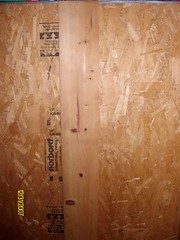 the 1/2 sheet of plywood for the top. This gets you the basic box. In one side cut a hole that you metal coffee can can sit in.
 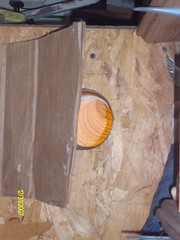 Mount the squirrel cage in the opposite corner, attaching the dryer vent to the cage and to the coffee can. Mount the fan on the same side but different corner of your coffee can.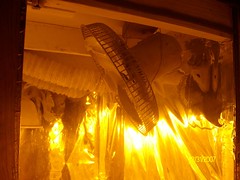
Then use 1x material for the door seem over lap and the hinge mountings on the doors. Attach the doors. Use your reflective material either before you put it together (as in the paint) or after (as in the Mylar). Hang the lamp.
We also use two reclaimed floor vents that have been placed on the bottom sides (either side) to help with air circulation.
Dimensions of our box is 6 foot by 4 feet wide 34 inches deep. and hidden behind our bedroom door (so don't give me that, I don't have the room). Using the egg cartons we have 264 seedlings, if we used the seedling flats, we could have close to 500 seedlings in our available space (egg cartons were readily available at this time).
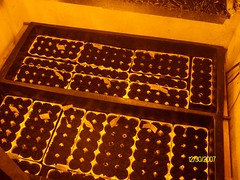
You can scale the box way down, we just used what we had instead of chopping everything up. 4x2x4 can be accomplished with 2 sheets a plywood, doing seed flats. (they are about 1ft wide 2 ft long)
You can do this in the corner of your garage, just make sure the temperature is regulated, between 80-90 f
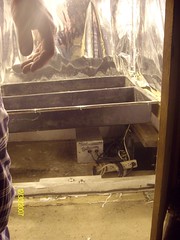
You will need;
We have very little money into this box, most of the things acquired where given to us, or we had laying about.
3 1/2 sheets of plywood
We had 4 sheets of 3/8 plywood 6 feet tall given to us (one reason for the shape of the box) 1 for the front, 1 for the back and 1/2 for each side, and 1/2 for the top.
2x4s in the corners and across the top
You can use a variety of light sources or heat mats with low light water bed heater, just keep the air moving so you don't turn your box into an oven. We run 400 watts in ours using a grow light
1x material
reclaimed door hinges, screws
A reclaimed squirrel cage
and dryer vent, and metal coffee can help vent out the heat so we don't scorch our plants. A small fan (was an osculating fan, but won't osculate anymore) that can be turned on to regulate any heating issues, and keeps the carbon dioxide levels up by exchange old air for new. The height helps with temp regulations as well.Mylar or anything reflective is used on the walls and the doors (glossy white house paint works, and is the cheapest of all the materials that could be used unless you have stuff laying about that you could use). The reflective stuff is used for light refraction, keeps the light bouncing around the box, maximizing your lumins.
Drip trays are need for any condensation or over watering.
What to do:
Split one sheet of plywood in 1/2 for the doors.
the 1/2 sheet of plywood for the top. This gets you the basic box. In one side cut a hole that you metal coffee can can sit in. Mount the squirrel cage in the opposite corner, attaching the dryer vent to the cage and to the coffee can. Mount the fan on the same side but different corner of your coffee can.Then use 1x material for the door seem over lap and the hinge mountings on the doors. Attach the doors. Use your reflective material either before you put it together (as in the paint) or after (as in the Mylar). Hang the lamp.
We also use two reclaimed floor vents that have been placed on the bottom sides (either side) to help with air circulation.
Dimensions of our box is 6 foot by 4 feet wide 34 inches deep. and hidden behind our bedroom door (so don't give me that, I don't have the room). Using the egg cartons we have 264 seedlings, if we used the seedling flats, we could have close to 500 seedlings in our available space (egg cartons were readily available at this time).
You can scale the box way down, we just used what we had instead of chopping everything up. 4x2x4 can be accomplished with 2 sheets a plywood, doing seed flats. (they are about 1ft wide 2 ft long)
You can do this in the corner of your garage, just make sure the temperature is regulated, between 80-90 f
Tuesday, January 01, 2008
Coming Attractions
Normally on this day, many of us are waking up, our heads pounding and resolving not to do it again. However, today I will not be talking about resolutions, instead I talk about what you might expect to see here at the Neophyte Homestead.
This past year has been an interesting one. I have learned to make fewer mistakes, though they are still rather abundant. I have taught myself to be a tad more patient. We have discovered that a donkey isn't always a donkey and that there are thieves no matter where you are.
So what can you expect to see this year? I can not guarantee you anything, as things abruptly change as this past year has shown me.
More White trash ingenuity, I mean repurposing.
a forced remod
more on the Tools Series
My life with a Donkey
Adventures in Sheep Shearing
Cows, friend or foe?
The Good Neighbor showed me....
How to catch a thief
How-not-to-do videos {with sound!}
Farm Market Follies
Goose dressing
I was thinking about bringing back
Choose your homesteaders adventure
and
Make it from Scratch
And then there is more of the same
gardening
canning
cooking
child rearing
mistakes {feel free to add mistakes to the end of any of these topics}
And your questions answered
I would like to take this moment to welcome all of you that have found my blog in your search for your newest resolution of Simplifying or Simple living. Although if you are here to green your life without working hard for it, you have come to the wrong blog.
Now let's see what '08 can throw at us. You ready?
This past year has been an interesting one. I have learned to make fewer mistakes, though they are still rather abundant. I have taught myself to be a tad more patient. We have discovered that a donkey isn't always a donkey and that there are thieves no matter where you are.
So what can you expect to see this year? I can not guarantee you anything, as things abruptly change as this past year has shown me.
More White trash ingenuity, I mean repurposing.
a forced remod
more on the Tools Series
My life with a Donkey
Adventures in Sheep Shearing
Cows, friend or foe?
The Good Neighbor showed me....
How to catch a thief
How-not-to-do videos {with sound!}
Farm Market Follies
Goose dressing
I was thinking about bringing back
Choose your homesteaders adventure
and
Make it from Scratch
And then there is more of the same
gardening
canning
cooking
child rearing
mistakes {feel free to add mistakes to the end of any of these topics}
And your questions answered
I would like to take this moment to welcome all of you that have found my blog in your search for your newest resolution of Simplifying or Simple living. Although if you are here to green your life without working hard for it, you have come to the wrong blog.
Now let's see what '08 can throw at us. You ready?
Monday, December 31, 2007
Planting a New Year
Some of your seed packages tell you that you should start seeds inside 8 weeks before last frost. And that is exactly what we did this weekend.

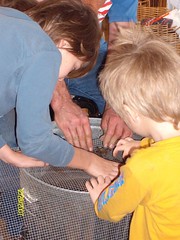
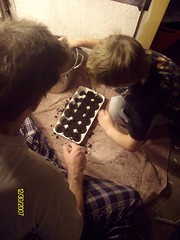
My husband sifted together the peat moss, chicken litter and soil. Even getting the boys to help out.
Once completed we prepped the grow box.
The soil mixture was then placed into one of my good stew pots {he thought he was being sneaking, but it does wash out} and then used a broken ice cream scoop to place the dirt into the egg cartons.
and then used a broken ice cream scoop to place the dirt into the egg cartons.We planted onions and brandywine, celery, climbing tomatoes,

and Good Neighbor Peas.
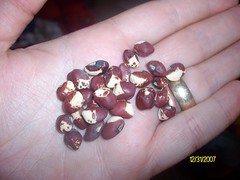
Once these sprout they will be moved to the nursery while a new batch of seedlings are placed in the box.
Have you started yours yet?
On a side note; thank you to whomever sent my the gift certificate to the photo studio. We haven't had a proffesional photo done in almost 10 years. Thank you thank you!
HAPPY NEW YEAR TO YOU ALL!
and Good Neighbor Peas.
Once these sprout they will be moved to the nursery while a new batch of seedlings are placed in the box.
Have you started yours yet?
On a side note; thank you to whomever sent my the gift certificate to the photo studio. We haven't had a proffesional photo done in almost 10 years. Thank you thank you!
HAPPY NEW YEAR TO YOU ALL!
Subscribe to:
Posts (Atom)
