Showing posts with label orchard. Show all posts
Wednesday, June 26, 2013
If I Had a Garden
I would be gritching about the heat. 100F+ for several days now.
Tomatoes will not set fruit in temperatures higher than 85F, some 90F degrees. Pollen becomes unviable. If it's super humid, pollen because too dense, heavy, to do much good. Keep the plants healthy by side dressing them with fertilizer. You can also try shading them with your awesome bed sheets, and have a light mister going during peak heat hours. They will fruit once the temperatures come back down. And when Fall sets in, don't forget that you can make all kinds of yummy dishes with unripened tomatoes.
The heat, as you know, kills the cool weather plants, but it also has detrimental effects on your cowpeas, common beans, corn and sorghum. ( cotton, rice and wheat as well, FYI). If your overnight temps are reaching above 75F, good luck getting any of the above to do much of anything.
If you are entering drought, or in a constant one, flooding the garden a few times a week, in the evening, will help the chances of your plants producing for you. Do not flood them every night, 3x a week, or when the soil at root level starts to dry, is all you need. Be sure to side dress with fertilizers! When watering, you need to remember that evaporation is a huge factor. You are losing more moisture than you think.
Do not flood your orchards, it causes the soil to lose the oxygen for the roots to survive. A good soaking is fine.
Well, that's what I would do if I had a garden.
Friday, April 27, 2012
The State of the Homestead
As my long time readers know, every once in awhile I post a general whose who of characters in something I call The State of the Homestead. And include how we are doing financially. This time we will do things a bit differently as an unofficial meme is running amok through the homesteading blogs. And since I seem to have amassed more readers, an introduction to the participants is in order.
And welcome to my world!

There are 5 of us humans here on the Neophyte Homestead, me; Phelan, Husband, and three boys, Small (8), Medium (10) and Large (14).
Cattle; Long Legged Kerrie's and American Milking Short Horns
9 cows and 4 bulls
Murrial
Mama
Urth's Umbra
Winston
Winnie
Xanadu
Xuxi

Yart
Yaya
Yoda
Yippie Skippy
Yogi
Zaphod
9 black belly Barbados sheep
Bobdole ( yes one word)
Ugly and lamb
Mini Ugly and lamb
Suzi and lamb
Burnt Marshmallow
Whitey

26 hens and 1 rooster
7 turkeys
3 dogs
Buckets
Sprocket
Axel
5 cats
Olive
May maybe manard
wrath
Alex
Envy
5 adult rabbits

Bees, no I am not going to count them
Poop ducks. They are wild, but a constant presence.
Plants, well let's just list trees. I use many weeds in our diet, flowers and then the 2400 sq ft garden.
1 peach tree
2 apple trees
3 crabapples
1 pear tree
2 hackberry trees
2 apricots trees
1 nectarine tree
3 plum trees
3 mulberry trees
2 cherry trees
2 paw paw trees
None are taller than Husband except one mulberry.
We have blue berry bushes, raspberry, blackberry, grapes, strawberries, hops,
It seems like I am missing something on this list. Hhmmmm. . . Oh and yes, 1 pecan and 2 walnut trees.
The State of the Homestead right now is a bit stagnant. Hay prices have come down, and we are talking with a manufacture about a steel building. We are actually talking about a house. Currently we are in a 30 year old mobile home that is falling apart. The steel company we are talking to has a layaway plan that takes a year. This will be the only way we could purchase something to begin building. We are not broke, but still below poverty level. Thank goodness we raise our own food. It's been a bit rough buying groceries after the drought last year. At least I didn't have to purchase any meat products. But things are looking up with this year's weather. Insects are worrisome though.
Boys are doing well. Medium was the only child in his school to score a perfect on his State Assessments. He has been wearing his medal for a couple days now. Large scored high enough to not have to take finals. Small won't take the State Assessment until next year. But he is doing wonderfully on his goals, has actually surpassed expectations. He will be in summer school though, just to keep it going. Medium is taking art and Large has to bring his GPA up so that he can go to school in Japan next year.
Husband is tired. Can't go into a lot about it right now though. Soon though, very soon.
Murrial and Yart have been separated from the rest of the herd. Due to their demeanor, they have been chosen to be the front yard cattle. Yart is so Eyore like, that she is easily handled. And a good calf for the boys to interact with. As I watch a couple walk their goat down the road, then another couple later walking their miniature pony, I have come to the conclusion that Yart and I should be taking strolls around the neighborhood.
Wednesday, March 28, 2012
Propagating Wild Blackberries
Good neighbor pulled in my driveway yesterday after noon. He came barring gifts, in the form of two 3 ft long wild blackberry cuttings. His mother has a blackberry monster, abut 100 years old, growing all willy nilly like on a large property she owns a few miles south of here. And as both good neighbor and I have been having issues with the domesticated type, he thought we should give the cutting a go.
Good neighbor merely cuts them, then shoves them in the ground. Which does work, but we here on the Neophyte Homestead are a bit more methodical.
Here now, don't go hacking up a wild blackberry bush. Get permission first.
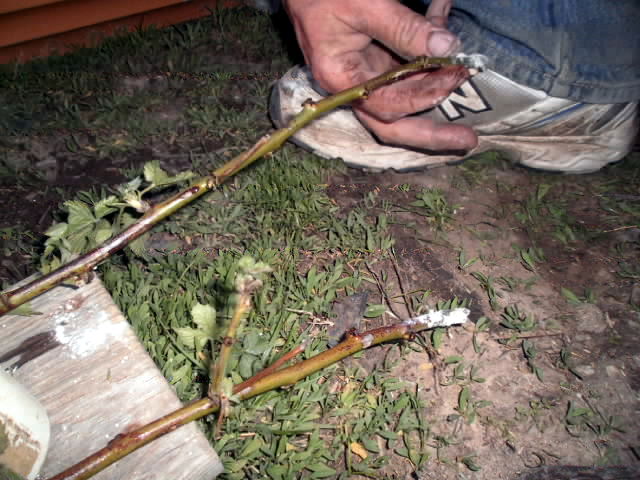
Pick out the stem you want, and try to cut it at an angle, a spear if you will. But if someone just hands you a stick that has been obviously cut with a semi dull knife, and is torn, we can work with that as well. Ain't picky here by golly. Push your razor or exacto into the bottom of the stem creating an X.
Now we are going to remove the small, newly forming stems/leaves a few inches up from the bottom of the stem.
Here is where I give a product shout out. I have had this bottle for 6 years, and haven't used anything else. So I am unable to give you a product comparisson. I use Schultz,
however I hear it told just about any cloning gel or powder works about the same. You want to get your stem wet, and apply the cloning or rooting compound to the very end of the stem, then on each of the knots where the small stems were removed.
As for your large stems, we trench them for a few weeks before planting. Plant them on their side in a shallow grave ( trench ), and allow the roots to form over a 2 week period. Then plant where you need them.
Your plants will go through a severe shock, and you will have to water the sticks for awhile. However they will grow roots if done properly, then return to their leafy state.
Propagation can be fun and relaxing, until the puppy yanks them all up and drags them all over the yard. If that happens replant. Cut any of the broken stems in the same way, compound, plant, moisten.
Good neighbor merely cuts them, then shoves them in the ground. Which does work, but we here on the Neophyte Homestead are a bit more methodical.
Here now, don't go hacking up a wild blackberry bush. Get permission first.
Pick out the stem you want, and try to cut it at an angle, a spear if you will. But if someone just hands you a stick that has been obviously cut with a semi dull knife, and is torn, we can work with that as well. Ain't picky here by golly. Push your razor or exacto into the bottom of the stem creating an X.
Now we are going to remove the small, newly forming stems/leaves a few inches up from the bottom of the stem.
Here is where I give a product shout out. I have had this bottle for 6 years, and haven't used anything else. So I am unable to give you a product comparisson. I use Schultz,
however I hear it told just about any cloning gel or powder works about the same. You want to get your stem wet, and apply the cloning or rooting compound to the very end of the stem, then on each of the knots where the small stems were removed.
Don't allow those removed stems go to waste. Dip the ends in water than your cloning or rooting compound, then plant. Moisten the soil and place in full sun.
As for your large stems, we trench them for a few weeks before planting. Plant them on their side in a shallow grave ( trench ), and allow the roots to form over a 2 week period. Then plant where you need them.
Your plants will go through a severe shock, and you will have to water the sticks for awhile. However they will grow roots if done properly, then return to their leafy state.
Propagation can be fun and relaxing, until the puppy yanks them all up and drags them all over the yard. If that happens replant. Cut any of the broken stems in the same way, compound, plant, moisten.
Tuesday, May 17, 2011
Mulch mulch mulch MULCH!!!
And that's when you wake up screaming.
We have a lot of mulch. And more is constantly showing up. We met a tree service guy. We set up a deal, whenever he is cutting trees in the area, he can drop it here. Most of the time, tree service companies have to pay to dump the mulch. So it is a good idea to call the tree service companies in your area, and let them know that you have a free dumping ground.
This tree service lives and works almost an hour from here, but is contracted with our electric company, so he goes where their poles are. We offered a place to park, saving him gas and money. I think he is now taking advantage of us, 1 hill is 6 feet by 10 feet wide, and 50 feet long! I can mulch the entire neighborhood!
We don't mind. We have mulched in all the trees, and a quarter of our 6,500 square feet garden. The walk ways for now. Once that's done, we will sift through the mulch, pick out the stringies and stick, and mulch in the veggies. This will save our food from drought at least. And I won't have to weed as much!
After mulching we contorted one of our apple trees. All it's branches are growing straight up. And with the apples forming, more sun will help.
Weird looking Christmas tree.
I will leave you with a bit o' cute
Hooter was over and was doing a Jack Nickleson impression for our Lamb, who looks like the Joker.
That got us rolling!

We have 6 kittens, all named after 1 of the 7 deadly sins. Together they make Pride.

We have named the bunny closest to the camera, What?.
Tuesday, February 10, 2009
The Best of me
My Husband is home!!! Oh, guess I forgot to tell you that little detail. My husband has been away for work these past 4 days. He got home last night. The car parked behind us at the airport watched as we made out, big cheesy grins on those guys' faces.
I had many comments yesterday, a whole lotta amens, but little on what you want to learn. I do have several years worth of info on this blog, so let's do some tags so you can pick what you want.
So there you go, some basics of my knowledge. Of course you can click on any of the tags to learn more about a subject. At least what I know. I do have specific tags, like apples, onions, mistakes.
I have a migraine, this is the best you get from me today.
Wednesday, May 21, 2008
Get a Clue
I will start posting later and later as the days progress. I will be doing more morning chores, like gardening, in the cooler temps of the morning. I will post, but in the afternoon, when the heat of the day drives me indoors.
I got to drive the tractor! I was actually able to take it away from my husband. We were beginning to think he was glues to the metal seat. We or ummm, I, cultivated the ditch that runs through our property. This is were all our water loving melons are being planted. One problem with this though. Because of where the cattle fence is, where the garden is, and where this cultivated ditch is, we can not get to the orchard. This is when we decide to put one of those bridge boards to use. We dragged it to the ditch using a lead. It took two of us, and we still struggled with it a bit.
Now we have access.
Of course while we were working,
the boys decided to brave the cows, and take a dip in the trough.
Later that day, I sent my boys to gather some fire wood. I wanted to practice my open flame cooking skills.
I made a simple dish of ham, noodle, cheese and spinach casserole.
I brought the water to a boil for the noodles,
heated the ham, melted the butter and cheese with a little milk
and allowed it to "bake" for a few minutes before serving it up.
The boys loved it, and it had a smoky flavor that can't be beat.
So, why am I practicing my open flame cooking skills? This is your clue to Monday's announcement.
Friday, November 30, 2007
Tools Used in the Orchard
This is part 5 of the Tools {used on my homestead} series. Part 1, Part 2, Part 3, and Part 4 can be found by clicking on the links.
Our orchard is still young. We were expecting are first harvest this year. But as some of you recall, to my horror, a late deadly frost covered my area, killing all the blossoms on my fruit trees.
This list will be incomplete, due to my lack of experience with the orchard. Those of you that have fruit trees, please, feel free to add to the list of tools needed in the comments.
For Planting, your best tool is your local extension office. Believe me when I say, use them up! Not only can you find some great deals on trees, but you can take soil samples in to be tested for a small fee. Testing the soil in the area that you wish to plant in will tell you what you need to add, or subject from the dirt.
Next are your trees.
Find trees suitable for your climate. I saw someone purchase a citrus tree just because the local farm store had one out for sale. But unless this person has an arboretums, I don't see it surviving in our brutal cold weather. Maybe it was a GMO, and spliced to make it here. I don't know, it was listed that I could see. Your local extension office will be able to tell you what tree thrive in your area, if you have any questions.
The next tool used is what ever was missing from the soil. As our top soil was stripped, we had a lot of "adding" to do. Mist of it was in the for of compost. Mulch is another thing to have on hand.
Once trees and your add-ins are on hand, planting is your next step. We use a spade for ours.
One reason we use this and not a shovel is because we snap shovels, just like we snap those potato forks. We work in the add-ins to the loosened soil with that ever present Garden Claw. And depending on what the add-in is, we may wait a few days before planting.
Once the trees are in, we must use stakes and tape to keep our trees straight. Otherwise that old reliable Kansas wind will have our trees almost laying down. Hoses now come into play. We are in the process of turning a horse tank into a rain barrel (will update you on the project at a later date) A water source is important (another up coming project is a windmill)
Pruning shears and a field knife are also tools e use. Some trees require certain pruning to happen. Shaping the tree to keep them from going "wild" is said to improve the fruit quality. The field knife come in use when suckers begin to grow.
Companion planting your orchard is a good idea, this tool we will call the cover crop. I am trying to locate clover seed for mine (as the bee hives are in my orchard) but there are other cover crops good for your orchard.
Lay out of the orchard is a good idea as well. Placement for your trees can help with pollination, even those trees that claim to be self pollinating can receive benefits from a companion.

This is an outdated drawing, as trees have been added.
We are prepared for a harvest. Bushel buckets, ladders, and netting. Hopefully next year looks like our apple picking adventure of last year.

Remember, by clicking on my tags, you can see other posts on the subject.
Our orchard is still young. We were expecting are first harvest this year. But as some of you recall, to my horror, a late deadly frost covered my area, killing all the blossoms on my fruit trees.
This list will be incomplete, due to my lack of experience with the orchard. Those of you that have fruit trees, please, feel free to add to the list of tools needed in the comments.For Planting, your best tool is your local extension office. Believe me when I say, use them up! Not only can you find some great deals on trees, but you can take soil samples in to be tested for a small fee. Testing the soil in the area that you wish to plant in will tell you what you need to add, or subject from the dirt.
Next are your trees.
Find trees suitable for your climate. I saw someone purchase a citrus tree just because the local farm store had one out for sale. But unless this person has an arboretums, I don't see it surviving in our brutal cold weather. Maybe it was a GMO, and spliced to make it here. I don't know, it was listed that I could see. Your local extension office will be able to tell you what tree thrive in your area, if you have any questions.The next tool used is what ever was missing from the soil. As our top soil was stripped, we had a lot of "adding" to do. Mist of it was in the for of compost. Mulch is another thing to have on hand.
Once trees and your add-ins are on hand, planting is your next step. We use a spade for ours.
One reason we use this and not a shovel is because we snap shovels, just like we snap those potato forks. We work in the add-ins to the loosened soil with that ever present Garden Claw. And depending on what the add-in is, we may wait a few days before planting.Once the trees are in, we must use stakes and tape to keep our trees straight. Otherwise that old reliable Kansas wind will have our trees almost laying down. Hoses now come into play. We are in the process of turning a horse tank into a rain barrel (will update you on the project at a later date) A water source is important (another up coming project is a windmill)
Pruning shears and a field knife are also tools e use. Some trees require certain pruning to happen. Shaping the tree to keep them from going "wild" is said to improve the fruit quality. The field knife come in use when suckers begin to grow.
Companion planting your orchard is a good idea, this tool we will call the cover crop. I am trying to locate clover seed for mine (as the bee hives are in my orchard) but there are other cover crops good for your orchard.
Lay out of the orchard is a good idea as well. Placement for your trees can help with pollination, even those trees that claim to be self pollinating can receive benefits from a companion.
This is an outdated drawing, as trees have been added.
We are prepared for a harvest. Bushel buckets, ladders, and netting. Hopefully next year looks like our apple picking adventure of last year.

Remember, by clicking on my tags, you can see other posts on the subject.

Friday, October 26, 2007
Can I Make You Fall for Planting Trees?
The other day, my husband and I loaded up the kids and took a trip to the local farm supply store. Our objective was to get feed for the goats and sheep, and the chickens, as well as a few heat bulb for our adolescent chickens. As we approached, we saw some of the trees that were left from the spring. Still green, but the leaves were falling off, they were fast approaching their dormant stage. As we got closer we saw the sign, the sign that changes your plans.
50% off our nursery stock.
SOLD! $9 for 3 year old fruit trees!?! You know we couldn't pass that one up. My husband and I looked at each other. Money? ~sigh~ I know. Fruit? yep. Should we? In the long run, it will be worth it. Agreed. {as I said previously, my husband and I are very articulate people}
There was about a dozen or so trees available. We looked at the tags, most were apples, but we already have 4 apple trees, 1 pear tree that has been graphed to produce 3 types of pears, a cherry, a peach and a plum. Our nectarine had been killed in the late frost earlier this year. And there it was, 1 nectarine left in the bunch. I took it. My husband declared that he loved my plum jam, so he decided that another type of plum was needed. It saddened me a bit, because the only reason we got our first plum tree was because of my father, so I was reminded of him. But my husband did indeed like the plum jam, so it was all good.
Wait a minute Phelan, it is cool out now. I know, I hear you. That bitter north winds are starting to cut through the landscape. Frost has arrived at least once by now. Why on earth would we go ahead and buy trees to plant? Autumn is a prime time to plant trees. With them in their dormant stage, they have time to establish roots systems without worrying about getting nutrition to the rest of the sleeping tree.
Bare root and burlap roots are the best for fall planting, but if you happen to find a deal like we did, and the trees are in containers make sure they get the required amount of water. Plant your fall trees as you would your spring ones. They need to be mulched in with organic materials, in wide shallow holes. If you can get them in the ground before the hard freeze of winter, before the soil loses it's warmth, you will see that those fall planted trees do better, then your late spring, early summer ones.
I would suggest going out this weekend to the places you saw the spring time trees for sale. More than likely they are on sale, and you can get a great deal. Any questions?
Tuesday, August 28, 2007
Late August Morning
We are not suffering from drought this year.
August in Kansas should look like this
Instead it looks like this
No, not complaining.
Even with the rain fall, some of my trees in our orchard are struggling. I am starting to think it has more to do with the soil than with the amount of water they are receiving. In some areas, despite the rain, the clay is hard and cracked. Other places are soft and yield gentle under your feet. Just looking out into our field you can see the marbled effect of the clay. It has been the cause of some stress here. We are unsure if we are going to make it.
We have an apple and a cherry tree that are the same age. The apple tree is touching 6 feet in height, while the cherry, who stand only a few feet away, is struggling to touch the 3 foot mark.
We choose an area that the field grass was struggling for life to plant our grapes. It should have been a perfect area, the grapes would concentrate more on their berries then the foliage. That is not the case.
I have followed the advice of books, yet have rarely been successful with their sure things. Time now to do it our way. If this means re-landscaping, then so be it. But something has to change if we are to make it. I fear that this land will only be good for growing field grasses.
August in Kansas should look like this

Instead it looks like this
No, not complaining.Even with the rain fall, some of my trees in our orchard are struggling. I am starting to think it has more to do with the soil than with the amount of water they are receiving. In some areas, despite the rain, the clay is hard and cracked. Other places are soft and yield gentle under your feet. Just looking out into our field you can see the marbled effect of the clay. It has been the cause of some stress here. We are unsure if we are going to make it.
We have an apple and a cherry tree that are the same age. The apple tree is touching 6 feet in height, while the cherry, who stand only a few feet away, is struggling to touch the 3 foot mark.
We choose an area that the field grass was struggling for life to plant our grapes. It should have been a perfect area, the grapes would concentrate more on their berries then the foliage. That is not the case.
I have followed the advice of books, yet have rarely been successful with their sure things. Time now to do it our way. If this means re-landscaping, then so be it. But something has to change if we are to make it. I fear that this land will only be good for growing field grasses.
Thursday, May 17, 2007
Some Good News
Having a hard time getting on blogger this morning.
As the tittle states, I have some good news. I went out yesterday to inspect the orchard. With all the rain and warm weather, I had a glimmer of a hope that some of my berry bushes survived that late hard frost. One of seven blackberries made it, one of three raspberries and one of three blueberries. All my grapes are going strong. One of two nectarines are ok, all my apples, my pear trees are fine. My peach tree isn't going to produce this year because the blizzard killed off all the flowers, but it looks like it survived.
Have I mentioned I loathe gardening? No? Well there comes a point where I feel that I am finished planting, then look over and things waiting to be put into the ground have multiplied. How did I end up with 42 tomato plants? Some days I would like that instant gratification that comes with driving to the grocery to get whatever I want right then and there. I always feel this way at this time of year, give me until harvest and I will be giddy with the excitement of fresh veggies. Nothing taste better.
Last Saturday I visited my local Farm Market. For being so early in the season, we had twice as many vendors then we did at the same time last year. Green houses hadn't offered seedlings in the years past. A new bakery was present, so I bought some bread for them. A local beekeeping couple was there, she was a tricky one. All I wanted was a large bottle of her honey, yet I walked away with the industrial size bottle. What am I to do with a gallon of honey? Also a couple from Haven, Kansas were selling their organic beef. Greener Pastures. I bought 5 lbs of hamburger, 4 KC Strips {nice and thick} and 8 minute steaks. All in all I spent under $100US on everything. Surprisingly enough, the steaks were cheaper than at the grocery. If you are new to the Farm Market scene, it's best to look around and price before going forth and purchasing, and sampling a little of each vendor is a good idea, no two steaks will taste the same {unless they are grain fed and mass produced} Once you figure out who you like, buy a little extra to freeze can or preserve to help you through the winter. That is if your markets are like ours, seasonal and open air.
Wednesday, April 11, 2007
As I bit into the nectarine,
While at the farm store last week, I noticed something very odd. They had a Naval orange tree for sale. These trees tend not to survive temperatures under 30F. This tree was outside, not in a green house, and I am sure it didn't survive this cold snap.
I digress, I was going to tell you about Nectarines. They are glorified Peaches, so please refer to my peach post for planting and care.
Nectarines can be planted from seed, but you are running the risk of getting peaches instead. Sometimes your nectarine will produce both peaches and nectarines at the same time, this is something Darwin called Bud Mutation.
That was a short post. . . any questions?
I digress, I was going to tell you about Nectarines. They are glorified Peaches, so please refer to my peach post for planting and care.
Nectarines can be planted from seed, but you are running the risk of getting peaches instead. Sometimes your nectarine will produce both peaches and nectarines at the same time, this is something Darwin called Bud Mutation.

That was a short post. . . any questions?
Tuesday, April 10, 2007
I am going to complain,
My shoulders are screaming. You do not under any circumstances mix wet, cold weather, bad shoulders and scythe work.
I went and tried using my Christmas present for the first time yesterday. The mighty pampas won. I had to stop only half way through the plant. I think sharpening the blade will help a bit.
This was what I was afraid of . . .
My peach tree. The blossoms have been killed.
One of my grapes, all of them look like this. I am hopeful everything will bounce back. But I am cautiously so.
All my broccoli and cabbage plants are dead. My potatoes are snug under a thick layer of straw. But one never knows what will happen.
Today I will be heading into town to buy donkey supplies. I have my list, now let's see if anyone has them.
I went and tried using my Christmas present for the first time yesterday. The mighty pampas won. I had to stop only half way through the plant. I think sharpening the blade will help a bit.This was what I was afraid of . . .
My peach tree. The blossoms have been killed.
One of my grapes, all of them look like this. I am hopeful everything will bounce back. But I am cautiously so.All my broccoli and cabbage plants are dead. My potatoes are snug under a thick layer of straw. But one never knows what will happen.
Today I will be heading into town to buy donkey supplies. I have my list, now let's see if anyone has them.
Monday, April 09, 2007
Frost Damage
Sorry I missed Make it from Scratch Sunday, again. I won't be able to do it next weekend either, gggrrr....
apple
On the bright side, my late blooming berries and fruits should be fine. Everyone is mulched in and trying to keep warm. I still have a few sticks in the house waiting to be planted, I will have fruit this year, in one form or another.

The snow and freezing temperatures may have reeked havoc on my young fruit trees, especially those that had already began to flower. Alrescate was right in her reply " I suppose the snow knocked down the pollen count at least..." Unfortunately that was not something that we needed. Yes, I know there are many people that are grateful not to suffer with their allergies if only for a few days, but those of us that are attempting orchard's, well, it's a whole other story. We need those pollen counts to be up so that are trees can bear fruit. With this cold snap, the pistons of my peach tree, which are the most delicate part, will not be able to reproduce. If they are able, then there is a high chance that my peaches will be deformed, and not very tasty. And the only way we are going to know is by waiting until the summer.
appleOn the bright side, my late blooming berries and fruits should be fine. Everyone is mulched in and trying to keep warm. I still have a few sticks in the house waiting to be planted, I will have fruit this year, in one form or another.

Last year's sticks
Wednesday, April 04, 2007
Be nice
The above is a very badly drawn orchard, my orchard.
My father is going less frequently to the VA, so yesterday we went and wondered around the farm store. We ended up buying a pear tree {no partridge} and 2 more apples, as well as a blueberry, blackberry and 2 more grapes. Now I need to figure out were they should go. I don't want to put anything on the bottom of my drawing, under the waterway. The apple in the above scene might not be able to stay there due to the new house. The green and yellow represent open field, there is were we want to keep live stock, all this is on about 2 acres of my 5.
decisions decisions. . .
Wednesday, March 28, 2007
Loud roared the dreadful thunder,
The rain a deluge showers. ~ Andrew Cherry
The sour cherry is one of the hardiest trees, standing up to just about anything that nature can throw its way. While your sweet cherry is more sensitive, and thrive well in light sandy soil.
Your young trees do not care for the cold, so do not plant them until after all threat of a spring frost has past. As cold air like to sink, your ideal spot to plant a cherry tree is on a slope that is higher than the surrounding area, and near a pond or stream if you have one. Water tends to reduce the dangers of frost. Plus it will prevent every young cherry trees nightmare, early spring flowering.
Your soil needs to be well drained. Though sandy loam is the best soil for all types of cherry trees, they will thrive in just about any type of soil.
Their roots rarely go deeper than 2 feet. You will need to help them get a little deeper to survive a long winter or flooding. To do this, add peat and compost with the soil you are working in around the root {only if you do not have sandy loam to begin with.}
The need lots of room. The amount of sunlight they get will add in fruit development. In the shade the fruits will fail to ripen. Choose a dwarf tree if you don't have a lot of space. Dwarf cherries need to have space of 18 feet, and standard will need a space between 25-30 feet.
Plant your cherry in an area that will be plowed in the fall. To plant you will need a cherry tree that is at least 2 years in age. Water the roots as soon as you get home. Never allow your roots to get dry.
Trim off any roots that have become damaged. Shorten up any stragglers. Plant so that they stand deeper in the ground than they did at the nursery.
Do not allow weed or grass competition with your tree. Mulch well if you are planting in sod, straw and cut up corn cobs are best to use. Cover crops like rye in the spring , and buckwheat in the summer.
At planting only have the main stem the tallest, trim back the others. Thin the stems to 4-6 inches apart, leave the lowest one about 16 inches from the ground. After that trim only the new branches on the main stem, the ones that will grow inward or cross over other branches.
What trees are you planting this year?
Monday, March 26, 2007
Really love your peaches, want to shake your tree
Ellie over on The Cedar Chest is winking at me.
I grew up in a small town, this was only a few years before it officially became a suburb. {Once upon a time, the city was far far away} This small town was known as the Peach Capital of the World. The orchards are now gone and tract housing in their place. The town, sorry, burb, has now become ugly and cold. I no longer drive through, because it is a painful sight to all my childhood memories.
I bring all this up, because my Peach tree has flowered. This is its third year, and when they typically begin to fruit. When selecting your young tree, it should be relatively straight and have buds. When ready to plant, cut the tree back to 18 inches above ground level. Watering should be done once a week, and you need to keep weeds cleared, the peach trees root systems are not very deep and can suffer from weed competition and drought. Sucker growth needs to be trimmed with a knife, if not done, the sucker will grow faster than the trunk and soon your peach tree will be wild.
Your third year you will want to fertilize well before the fall rains. Prune it back before February, in many cases you will have to cut it back by 50%. Do not allow all the fruit to stay on the limbs, you can get 50 peaches on one small branch, these need to be thinned out to 10 -12 inches apart, possibly only leaving you 3 fruits or so per branch. This will give you a better quality and tasting peaches. Thinning is also an important part to keeping the tree alive. Too many fruits can damage and possible kill your tree. The first thinning should take place when the peaches are about the size of a pea, then again when they are marble sized. You will want to go over the tree at least three times.
If the winter is too mild, your tree will not be able to go through its natural dormant period. This will cause flowers to bloom without leaves, a process called delayed foiliation, and it can be dangerous for your tree. Without leaves, the tree will be unable to care for its fruit, when this happens you will need to remove most of the fruit and the leaves should arrive in late spring. Your tree will have weakened and will hopefully rebound the next year. Try keeping the ground wet around the base of your tree to keep it in its dormant state longer. This is also a good way to prevent early blooming and frost damage.
Keep your tree trimmed so that it will grow wide and not tall. Also keep the area well fertilized, but without chicken manure. Too much nitrogen content. Cover crops can also aid in the health of your tree. Rye and vetch seem to be the best.
Keep could care of your peach tree and the tree will keep you supplied in its wonderful fruits for years to come.
Wednesday, June 14, 2006
Trees

One of the biggest mistakes we made when buying our land, was buying a place with very few trees. There is no wind blocks. And a typical day in Kansas, you will be greeted by at least 20 mph winds. We set about ordering different types of shade and wind blocking trees. Soon we were ordering fruit and nut tress along with berry bushes.
In four years we have planted over 100 trees. We walk through our fields looking for a wild saplings to transplant. And now have a small orchard that in a few years will start producing, and we will have apples, cherries, apricots, nectarines, peaches and many different nuts. We learned two winters ago how important trees really were. An ice storm fell hard on us, with no electricity and nothing to block the bitter cold, we had to leave our homestead and stay in the city for a few days. Then a few months ago we had a dust bowl. Our small trees did nothing to stop the grit that found it’s way into our mouths as we tried to tend to the birds.

The grey sky is dust
Subscribe to:
Posts (Atom)