Donate Now!

Donate Now!
Buy a membership or koozies to help!

Saturday, July 25, 2009

Sing Along- songs pre-1919

WHEN BOB GOT THROWED

THAT time when Bob got throwed
I thought I sure would bust.
I like to died a-laffin'
To see him chewin' dust.
He crawled on that Andy bronc
And hit him with a quirt.
The next thing that he knew
He was wallowin' in the dirt.
Yes, it might a-killed him,
I heard the old ground pop;
But to see if he was injured
You bet I didn't stop.
I just rolled on the ground
And began to kick and yell;
It like to tickled me to death
To see how hard he fell.
'Twarn't more than a week ago
That I myself got throwed,
(But 'twas from a meaner horse
Than old Bob ever rode).

D'you reckon Bob looked sad and said,
"I hope that you ain't hurt!"
Naw! He just laffed and laffed and laffed
To see me chewin' dirt.
I've been prayin' ever since
For his horse to turn his pack;
And when he done it, I'd a laffed
If it had broke his back.
So I was still a-howlin'
When Bob, he got up lame;
He seen his horse had run clean off
And so for me he came.
He first chucked sand into my eyes,
With a rock he rubbed my head,
Then he twisted both my arms,—
"Now go fetch that horse," he said.
So I went and fetched him back,
But I was feelin' good all day;
For I sure enough do love to see
A feller get throwed that way.
Ray.
Our horse Sammy on the left. Her papered name is Seminole Wind.

Cows back home, and I want to cry

So that I can keep on track, this will be my official 1030pm post.

My wonderful husband, who was late, left the gate open. 5 cows got loose. I am already in pain. But alas, I maned up. It took a bit, looks like a half hour or so, but I managed to get them all back in. I am over heated, exhausted and about to throw up. My back hurts way too much. Oh how I dream of living that suburban life once again.

I took a very cool shower to cool myself down, screamed a bit when I had to put my shirt back on and my hair into a rubber band. Some one want to trade places?

The winner of the warning sign contest and will be getting the Biker novel "A Little Twist of Texas" is....

Kelly and Alex of Mainly Ewes Farm. CONGRATS! Please email me your shipping address. (they got extra points for doing it at work)

back

did I miss anything?

be back

this counts as my entry

cows are out!

Fact Sheet: Genetic Engineering

Genetic Engineering

Why is corn pollen suspected of killing Monarch butterflies? Why are Mexican corn farmers afraid of the wind? Why do many countries refuse to buy American crops?

Since the introduction of genetically engineered (GE) products (also commonly referred to as genetically modified organisms or transgenic) to the market in the mid ‘90s, genetic engineering has sparked a global controversy. Environmental hazards, food and crop contamination, declining market prices, and political battles are all side effects of the genetic tampering with your food.

Genetic Engineering: Science in the Wild

  • Genetic engineering is the manipulation of specific genes that are moved from one species to another to create a trait that didn’t previously exist. For example, fish genes have been transferred to tomatoes and bacteria genes have been transferred to corn.
  • Common crops, such as corn, have been engineered to contain pesticides in every cell of the plant. As a result, these crops are not registered as food - they are actually considered pesticides.
  • Companies in the United States are predominantly focused on developing herbicide-tolerant crops, which means that herbicides can be sprayed directly on the crop without damaging the plant itself. By 2005, herbicide-tolerant soybeans accounted for 87 percent of total U.S. soybean acreage, while herbicide-tolerant cotton accounted for about 60 percent of cotton planted.
  • Nearly 60% of processed foods contain genetically engineered ingredients.

Genetic Engineering: Threatening Farmers Worldwide

  • Farmers buy GE crops based on promises of lower costs and higher yields, but they often find additional costs in veterinary bills, medications, unstable markets and extra pesticides. In short, farmers often encounter higher costs and lower yields with GE crops.
  • Biotech companies have yet to introduce a GE crop that increases yield, enhances nutrient content, resists disease or tolerates salt or drought.
  • Farmers that buy GE seeds enter into a contract that dictates how and when the crop can be grown and forbids the farmer to save seed - contrary to traditional practices.
  • Many farmers have been sued by GE seed companies for allegedly saving seeds, while neighboring farmers whose crops have been contaminated by GE pollen drift have been sued for unknowingly "possessing" GE seeds.
  • The prevalent usage of GE crops increasingly threatens the biodiversity in our seed supply, making our crops more vulnerable to disease outbreaks and pest infestations.
  • With the continued planting of GE crops, whatever safeguards we have left to protect consumer right to purchase non-GE products and farmers’ right to access, grow and save non-GE seed are seriously compromised.

Genetic Engineering: A Public Health Hazard

  • While the Food and Drug Administration claims GE products on the market are totally safe, there has been no thorough analysis of their long-term implications.
  • Due to the extremely unpredictable nature of genetic experimentation, new food toxins, allergens or diseases can and have resulted from genetic engineering.
  • Health risks also include increased antibiotic resistance stemming from the use of antibiotic markers in the development of GE seed.
  • Weak regulations and corporate oversight have allowed experimental crops to contaminate the general food supply. For example, in 2002, corn that had been genetically engineered to use as a vaccine for diarrhea in pigs, contaminated 500 bushels of soybeans that were intended for the general food supply.
  • The biotech industry has undue influence over government regulatory institutions. A Monsanto executive drafted a proposed legislation for the legalization of one of its products, rBGH, a genetically engineered growth hormone used to boost milk production in dairy herds. She was then hired by the FDA to inform public policy on the very same topic.

The government may have already cast its vote for genetic engineering in agriculture, but it remains a controversy in the minds of consumers and many family farmers. In 2001, Farm Aid helped create the Farmer to Farmer Campaign on Genetic Engineering, an organization still hard at work today informing family farmers and consumers who care about the environment about the legal, financial and health implications of genetic engineering in agriculture. Cast your vote: buy family farmed and organic to get GE-free food.


Source: Farm Aid


Still time to pledge!


For every $5 you pledge you will be entered to win a $100 gift certificate from Outer Sports (I am still drooling over knives) And if you pledge before midnight centeral time, you will be entered to win an 8x10 award winning photograph from my homesteading mentor.

Pain and Marx

Watching the Marx Brother's. I really enjoy old movies, comedies are great, but horror is better.

Pain pills taken, will see if it works at all.

Don't forget to pledge. You could win some great prizes.

I'm hurt

I went to get everybody's snack to them for the evening. Sammy (horse) decided that Donkey (sheep) shouldn't be allowed to have a treat. And some where or another I got into the mix and now I am hurting. My back from my spine to my left bicep, and now the shoulder blade of my right side.

This will be a very long night

CONTEST! Prize? yep there is one


Show me your best Warning sign. Go here>>> and create one.

Unfortunately blogger won't allow you to use image script on replies, so post in on your blog and leave a link in comments, or email it to me if you want for you chance to win "A Little Twist of Texas."

I will leave this open until 10pm central time, 3 hours from this post.

Who I am Blogging with

Blogathon.org asked who we were blogging with.

Who I am blogging with

Like this surprises any of you.

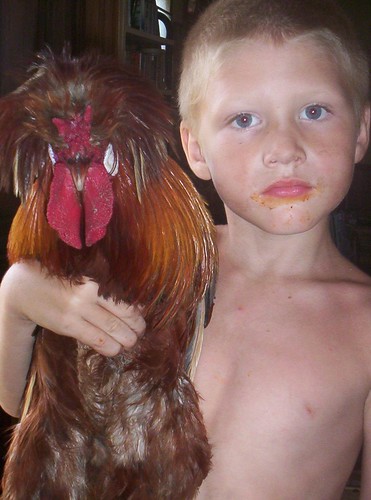
I think it is shower time for Small. (that would be the boy, not his rooster. Which is still in the house!)

You too can help more little boys keep a rooster. Just pledge $5 to help Farm Aid. For every $5 pledge you make, you will be entered in a chance to win a $100 gift certificate to Outer Sports. And if you pledge before midnight central time, you will get a chance to win an Americana photograph taken by a real homesteader!

A Few Chores


A little gardening


gathering eggs from various odd spots ( we love those feed bags, although it isn't what we feed our animals. The bags get reused for all sorts of wonderful things. And as I am the white trash of the area, neighbor are always bringing them to me)

Milking, after I clean up a little poo


Feeding the goats

Farmer Heros: Rick and Lora Lea

Northeastern, Wash.

“Quillisascut Farm School instills an awareness of a sustainable planet. There can be no greater connection to food than to be immersed in the place where it is grown, where all of your senses are involved…your hands in the dirt, the heady smell of cheese in process - each meal a culmination of the days work.” - Karen Jurgensen, Executive Chef, Baci Catering and Cafe

Enthusiasm for adventure, love of country living and a dream of farming brought Rick and Lora Lea Misterly to the Huckleberry Mountain range of Northeastern Washington 23 years ago where they founded Quillisascut Farm. Lora Lea has a background in small-scale dairy farming and cheese making. Rick attended Pierce College of Agriculture and is an avid gardener. Today, the Misterlys hand-milk approximately 35-40 goats and maintain a herd of just over 50. In addition to dairying, the couple also maintains a working garden, an orchard and a vineyard on their 36 acres.

While Rick handles most elements of animal husbandry on the farm, Lora Lea preserves her family tradition of creating farm-made cheeses. She has been expanding on her mother’s recipes and techniques in order to distribute a variety of cheeses to local markets and restaurants.

“Our main market is Seattle area restaurants, and most local chefs have no taste memory for farm made cheese. In other countries, where there is a market in every town, people have a greater connection to where their food comes from,” Lora Lea says. “Just as it takes loving care to cook good food, it takes loving attention to teach people about where it comes from.”

This holistic approach to understanding and appreciating food was not always something that her buyers understood or valued. Rather than dismissing this lack of understanding in her customers, however, Lora Lea and Rick devised a plan. The couple decided to use their farm to teach chefs and food professionals a new respect and understanding about the very beginning of food. Thus, the Quillisascut Farm School of the Domestic Arts was born.


Read more here>>>>

Chores in 20 minutes

ok, so doing farm chores in 20 minute intervals isn't very fun.

"MMMMMOOOOOOOOMMMMMMMYYYYYY! times almost up!" I have to sprint from the barn back to the house.

milking, oh what fun it is to milk in a little time. Lucky for me I have Dexters. They only ake 10 minutes or less to deal with. Murrial, my American milking shorthorn will be another story entirely. Good thing husband will be here by then. I am going to take a break for the next few moments. Maybe take some pictures. Anything you want to see?

The winner of the Candle is The Thinker! Please email me with your shipping address!

Fact Sheet: Globalization and Consumer Choice

The global trading of food has emerged as one of the most serious threats facing family farmers in the U.S. and around the world, and one of the most difficult to overcome. Agricultural "free trade" agreements, like the North American Free Trade Agreement (NAFTA), promote the trade of agricultural products with little regard to the negative impacts on local communities and family farmers. Countries, including the U.S., have been flooded with cheap food imports. The low-cost appeal of these imports to consumers has caused farmers to lose their local markets. Consequently, family farmers worldwide have been forced off their land, weakening local food production, and consumers are becoming more dependent on food imports. Free trade agreements pose a threat to domestic food security - a problem that affects people worldwide.

Free Trade: Forcing Farmers Off the Land, Spreading Rural Poverty and Hunger

Since the 1994 signing of NAFTA which linked the economies of the United States, Canada and Mexico, family farmers in all three countries have felt the negative impacts of a free trade agreement designed to benefit agribusiness corporations.

  • In the U.S., 100,000 family farmers were forced out of farming between 1996 and 2001. During that same time period, Canada lost 11 percent of its family farms. (i)
  • NAFTA has dramatically increased rural poverty and hunger in Mexico.
  • Between 1992 and 2002, the percentage of rural Mexicans living in extreme poverty grew from 36 percent to 52.4 percent. (ii)

Free Trade: Unfair Profits for Multinational Agribusiness Corporations

Free trade agreements have fueled the expansion of corporate concentration and control of food production from the national to the international level,unfairly boosting the profits of many US-based corporations.

  • Under NAFTA, Archer Daniels Midland's profits went from $383 million in 2001 to $451 million in 2003, while Cargill's net earnings from the same time period jumped from $333 million to $1,290 million (iii) while thousands of family farmers have been forced off their lands due to low prices.

Free Trade: Taking Away Consumer Access to Family Farm Food Systems

  • Decisions about how our food is grown and by whom are made behind closed doors. Trade and agricultural ministers have allowed multinational corporations to gain unprecedented power and control over our food system. As a result, Americas reliance on imported foods is increasing.
  • After consumers and farmers fought successfully to have mandatory country of origin labeling (COOL) included in the 2002 Farm Bill, the current administration delayed the mandatory labeling until 2006 because of heavy lobbying by agribusiness. This is a blatant example of corporations working against the interests of family farmers and consumers and the U.S. Department of Agriculture dragging its feet on implementation of policies that would benefit family farmers and consumers alike.

Fair Trade, Not Free Trade!

Each country must retain the right to determine how to meet its domestic food needs while protecting its family farmers. Consumers, largely left in the dark about the negative impacts of cheap imports within the domestic food system, should have the right to choose who grows their food, how it is grown and where it comes from. Free trade policy is typically unfair trade policy.


Source: Farm Aid

A quick reminder, pledges before midnight central time get a chance to win an incredable photograph, and for every $5 you get a chance to win $100 gift certifacate to outer sports. (I never see you money nor the prizes)

Farmer Heros: Mark Parrish

Boston, Mass.

It's amazing how having kids forces one to look at things in a new light! As a new father concerned about my child's health, I was determined to find milk that was free of hormones. After investigating the brands of milk sold at my local supermarket, I became distressed to learn that all contained milk from cows injected with rBGH -- a genetically synthesized hormone produced by Monsanto to increase milk production.

One day last summer at a local county fair, I stopped into a tent to for a taste-test of a locally produced milk from a farm called Crescent Ridge. Not only was the taste far superior to the brand that I had been buying for years, it was also hormone free. I became a new customer on the spot!

Crescent Ridge Dairy is a 44-acre family-run dairy operation just outside Boston, MA. The farm has been producing and directly selling milk to local residents since the late 1800s. Once surrounded by other farms and open space, Crescent Ridge is now hemmed in by encroaching housing developments. The barn and cows even look out of place in this increasingly suburban setting. But unlike many other New England dairies that have folded over the past decade, Crescent Ridge has figured out not merely how to stay in business, but how to grow in difficult times.

The Parrish family bought Crescent Ridge (CR) in 1932. Mark Parrish is the third generation of his family that has run the farm. I recently visited Mark to better understand the challenges of dairying in New England and its prospects for the future.

CR milk gets from the cow to my breakfast table in 1-3 days. Faced with intense retail competition that blocks small producers from the supermarket shelves, CR began a home delivery service as a way to boost their business. A quality product combined with home delivery has enabled CR to be one of the few independent dairies in the region that is financially viable. CR now has 8,000 home deliveries per week. Read the entire article here>>>


Can I stomp my foot and say not fair!?! We are trying to change the laws here with regards to raw milk.

Sing along

OUT WHERE THE WEST BEGINS

OUT where the handclasp's a little stronger,
Out where the smile dwells a little longer,
That's where the West begins;
Out where the sun is a little brighter,
Where the snows that fall are a trifle whiter,
Where the bonds of home are a wee bit tighter,
That's where the West begins.
Out where the skies are a trifle bluer,
Out where friendship's a little truer,
That's where the West begins;
Out where a fresher breeze is blowing,
Where there's laughter in every streamlet flowing,
Where there's more of reaping and less of sowing,
That's where the West begins.
Out where the world is in the making,
Where fewer hearts in despair are aching,
That's where the West begins;
Where there's more of singing and less of sighing,
Where there's more of giving and less of buying,
And a man makes friends without half trying,
That's where the West begins.

Arthur Chapman.

40 Farmers under 40

Written by Matt Hickman

Who do you picture when you think of an American farmer? A leathery-handed AARP type who rises at dawn, works the fields all day and returns home when Sally Mae rings the supper bell? If so, you aren't too far off. According to the USDA, the average American agrarian is a white male aged 55 or older. And some studies show that the presence of young farmers, 18 to 35, is actually in decline.

But while they might be dwindling in numbers, young farmers are growing in visibility. And they're a motley, stereotype-shattering crew, for sure.
They're urban, they hold advanced degrees and they're often female. They sprout up in not-so-bucolic places like Brooklyn, Oakland, Atlanta and Indianapolis, and they sometimes work as educators, eco-entrepreneurs, yogis, journalists, filmmakers, activists and doting parents on the side. They're passionate and adventurous. And most notably, they're focused on sustainability and community building.
The following list features 40 American farmers under the age of 40, compiled with help from dozens of people in the farming industry — from farmers themselves to those who help them in the nonprofit sector to those in the media who cover them. They aren't in any particular order (farmer No. 5 isn't necessarily better than farmer No. 15, for example), and in no way should this list be considered scientific. Think of it more as starting point, a beginning to a larger conversation about the collective hope for the future of American farming.
Straw hats off to older farmers — they're the agricultural backbone of this country — but it's also time to acknowledge that Young MacDonald has a farm, too. These 40 up-and-coming farmers are happily working the earth from Roy, Wash., to Tivoli, N.Y., and the crops they grow are just as diverse as their backgrounds. Without further ado, let's meet the gang ...

Meet them here>>>

I started homesteading/farming when I was 24. And I still fall into that under 40 crowd.

Food Labeling

There are many different food labels that contain information about how food was grown or processed. However, some labels can be misleading. Below are examples of labels to look for, ask questions about, and avoid. Send your questions about food labeling to ask Hilde, our resident expert.

Look for:

USDA Organic LogoOrganic: The National Organic Standards, regulated by the USDA, assure that food products must contain at least 95% organic ingredients and that no synthetic growth hormones, antibiotics, pesticides, biotechnology, synthetic ingredients,or irradiation were used in production or processing. Organic labels can be found on produce, dairy, meat, processed foods, condiments and beverages.

Fair Trade: Fair trade standards are enforced by the Fairtrade Labeling Organization International (FLO). Fair trade products must be produced in accordance with the following guidelines: Workers must receive decent wages, housing, health and safety guidelines, the right to join trade unions and child or forced labor is completely prohibited. Crops must also be grown, produced and processed in an environmentally friendly way. Fair trade standards have been established for coffee, tea, cocoa, honey, bananas, orange juice and sugar.

Free Farmed Certified LogoFree Farmed: The Free Farmed Certification Program was created by the American Humane Association in 2000 to ensure that animals raised for dairy, poultry and beef products are raised in a humane manner. These guidelines ensure that livestock have access to clean and sufficient food and water as well as a safe, healthy living environment.

The following labels depend on farmer and processor information to support the claim that the food products were raised in compliance with each set of standards. However, they are not certified or tested by any third party regulatory agency.

Feel Good Buying (not certified):

Hormone Free, rBGH Free: Some meat and dairy products are now being marketed as hormone free. In dairy products, this means that the farmer has chosen not to inject his cows with the artificial growth hormone called rBGH. Similarly, on beef

products this label indicates that the animal was raised without growth hormones or steroids.

Raised Without Antibiotics: This meat and dairy label indicates that the animal was raised entirely without the use of low-level and/or therapeutic doses of antibiotics.

GE Free, Non-GMO: Food products that use GE Free or Non-GMO labels are regulated by individual companies, distributors or processors. Often, the companies require certification or affidavits from farmers that the materials were not genetically modified in any way. Learn more about Genetic Engineering.

Ask Questions About:

All Natural: While many products have “all natural” labeling or packaging, there is no universal standard or definition for this claim.

Free Range: The Free Range claims that each meat or poultry product (including eggs) comes from an animal that was raised in the open air or was allowed to roam. However, the regulations do not specify how much of each day animals must have access to fresh air. For example, in poultry, the USDA considers 5 minutes adequate exposure to be considered free range. In beef the use of the label is completely unregulated or standardized.

Avoid:

Irradiated logoIrradiated: Irradiation, or cold pasteurization, exposes food to high doses of ionizing radiation, equivalent to millions of chest x-rays, in order to kill bacteria. This process destroys essential nutrients, creates toxins and carcinogens that remain in the food, and perpetuates dangerously unsanitary conditions in meat processing plants.


Source: Farm Aid

Here are some of the foods we grow here on the Neophyte homestead;


Everything except the wheat (for now)

Right now I am eating organically grown popcorn. Everything we grow or raise is organic and raw.

From Willie to Barack

Dear President-elect Barack Obama,


As President of Farm Aid, I'd like to take this opportunity to whole-heartedly congratulate you on your historic victory. I'd also like to offer you every resource that Farm Aid has available to assist you in creating a new farm and food policy that supports a sustainable family farm system of agriculture.


I started Farm Aid in 1985 when family farmers were being forced off their land as a result of federal policy that paved the way for industrial agriculture. This shift replaced independent family farmers with factory farms that have wreaked havoc on our communities, our environment and our public health.

There is broad agreement that our farm and food system needs to be drastically reworked. The good news is that the work of building an alternative to the industrial food system is well underway and Farm Aid is proud to have been a leader in this work, something we call the Good Food Movement. The Good Food Movement has grown and thrived almost entirely without the support of the federal government. However, now is the right moment for the leadership of our country to take a role in this important movement. In fact the future of our economy, our environment and our health demand it.


Our family farmers are a national resource with incredible potential to be the protagonists in solving the challenges we currently face. Family farmers are on the cutting edge of thriving local food systems and economies, alternative energy production and environmental stewardship. Family farmers are marketing the fruits of their labor close-to-home at farm stands, farmers markets and Community Supported Agriculture programs (CSAs), helping local money to circulate in local communities where it can do the most good. Family farmers are growing green energy and harnessing the power of the sun and wind. They are transitioning to sustainable production methods to grow food that is good for our health and our planet. These steps are strengthening our local economies, reducing our reliance on fossil fuels, protecting our natural resources and increasing our national security.


As the national organization working on behalf of family farmers for the last 23 years, Farm Aid has helped family farmers stay on the land, organized communities to fight factory farms in their own backyards, and educated eaters about the choices they can make to guarantee healthy, fresh food from family farms. Over our history, we have grown, partnered with, and sustained a network of more than four hundred grassroots farm and food organizations across the nation. As you begin to implement programs to support a family farm system of agriculture, Farm Aid and our vast resource network is here to work with you.

Now is the time for our country to recognize and call on family farmers' ingenuity, strength and value to our past and our future. We can have strong local economies, green energy, a clean environment, healthy citizens and good food—all of these start with family farmers. I look forward to working with you to make this vision of a family farm system of agriculture a reality.

Stay Strong and Positive,


Willie Nelson signature


About pledging, remember I never handle your money. It's like a PBS pledge drive. You call and pledge your money. Blogathon.org will send you a reminder after the thon is over and you go directly to Farm Aid's site to donate. If you pledge before 12am central time, you will be entered to win a gorgous 8x10 taken by one of my homesteading mentors, and for every $5 pledged, you will be entered to win a $100 gift certifacte to outer sports. Check out the side bar to see what else you can win.

Fact Sheet: Factory Farms

Factory Farms

The Worst of Industrial Agriculture

Factory farms, megafarms or Confined Animal Feeding Operations (CAFOs)(i) claim to be the future of American farming. Higher production levels, lower retail costs, and greater efficiency are all boasts of industrial agriculture. Certainly, factory farms are capable of producing large quantities of cheap food. But cheap food at what cost? The real costs of factory farms and cheap food far outweigh the benefits.

Factory Farms: Ruining the Legacy of Family Farm Food Systems

Every new factory farm forces 10 family farmers out of business (ii). With every small family farmer that has to leave the farm, communities lose access to fresh, healthy food and local economies are weakened.

Factory Farms: Abusing Animals and Polluting the Environment

  • Factory farms crowd tens of thousands of farm animals under one roof which denies them many of their most basic behavioral and physical needs, creates stress and exposes the animals to many serious illnesses. (iii)
  • In 1995, 25 million gallons of raw animal waste spilled from an eight-acre industrial lagoon in North Carolina, killing 10 million fish and closing 364,000 acres of coastal wetlands to shellfishing. (iv)
  • The U.S. Environmental Protection Agency (EPA) reports that manure runoff from factory farm lagoons is a significant factor in the growing problem of ground and surface water pollution. (v)
  • EPA and state regulations for waste management are easily circumvented and woefully inadequate. Many factory farms operate unmonitored and unchallenged.

Factory Farms: Threatening Our Health

  • Inside factory farms, the overcrowded living conditions in feedlots and factory barns promote the spread of diseases, such as salmonella. (vi)
  • To fight disease outbreaks and promote unnaturally rapid growth, factory farmed animals are routinely fed antibiotics; over 70 percent of all antibiotics in the United States are fed to healthy farm animals.(vii)
  • This indiscriminate use of drugs has directly contributed to the evolution of antibiotic resistant bacteria which the American Medical Association considers an impending public health crisis. (viii)
  • Recent studies have shown that people living near hog factories suffer from headaches, runny noses, sore throats, excessive coughing, diarrhea, and burning eyes - symptoms brought on by noxious gasses and water pollution from manure lagoons. (ix)
  • In more extreme cases, people living near factory farms have developed neurological diseases and women have suffered from miscarriages as a result of water and air contamination. Employees working inside factory farms have died from exposure to manure lagoons. (x)

Family Farmers Fighting Back

In 1994, Farm Aid helped to kick-off the Campaign for Family Farms and the Environment, a national effort to stop factory farms and those commodity groups that work against the interests of family farmers. Farm Aid knows that we all depend on farmers for high quality food, a strong local economy, and a healthy environment.

By demanding fresh, healthy food Farm Aid and its supporters can send out a clear message:family farms, not factory farms, should be the future of American agriculture. Learn how to help family farmers and make sure you will always have a choice for fresh, family-farmed food.


Source: Farm Aid

Contest! Prize? Handmade Soy Candle

Comfy Cottage creations has donated a 16 oz handmade soy candle. Here is your chance to win it.

what to do:

Post a blog entry about me (A homesteading Neophyte or Phelan), the Blogathon, and Farm Aid. Link it to this post, then come back and leave the link to the entry. The most creative, original post will win. I promise not to sue you for slander.

This contest will be left open until 1230 pm central time. 2 hours from this post.

No one knew the answer to the last trivia question? They will only get harder! This trivia question will help me stay awake and interactive throughout the 24 hours, indulge me.

Remember that if you pledge before midnight central time you will be in the drawing to win a photo by one of my mentors. And for every $5 you pledge, you will be in a drawing to win $100 gift certificate to Outer Sports (check out their site, so many this to drool over, like the knives)

Pledge now

Fellowships in the Farming Community

The Burkett family has been putting down roots in the soil of Petal, Mississippi for one hundred and twenty-one years. "I can remember delivering watermelons to the market in New Orleans when I was just a little fella," says lifetime farmer and farmer advocate Ben Burkett. On a family farm that was once fluffy-white with cotton, Ben now grows sixteen varieties of vegetables ranging from okra to sweet peas as well as organic herbs. You can still find him selling melons at the Crescent City Farmers Market in New Orleans and the Hattiesburg Market in Mississippi.

Like most farmers, Ben wears many hats. He is also the director of the Mississippi Association of Cooperatives, which is an arm of long-time Farm Aid funded group Federation of Southern Cooperatives/Land Assistance Fund. Born from the Civil Rights Movement of the 1960s, the Federation works in sixteen states across the southeast, with particular focus on Alabama, Georgia, Mississippi and South Carolina, to increase the income and enhance community development in some of the poorest parts of the south.

For farmers, this includes to outreach and education programs that help create and support credit unions and farmer owned cooperatives. Regardless of size or scope, all cooperatives share certain elements in common. Membership is voluntary and democratic. The goal of a cooperative business is to meet the common economic, social and cultural needs of its members - a concept that was very important to the founders of the Federation.

Federation staff provide training and technical assistance to seventy-five farmer cooperatives, like the one that Ben Burkett belongs to in Mississippi, the Indian Springs Farmers Association. "There are a lot of benefits to belonging to a co-op," explains Ben. "The market is more regular and there is camaraderie. Every time I go there, I learn something new [from the other farmers]. There is a sense of fellowship." read entire article here>>>


There is around 200 bloggers doing the blogathon this year. So many causes that are worth our attention. If you haven't found the blogger you wish to sponsor, or want to help them by leaving comments, or are just curious, try the blogathon frame, here. Surf through and see what is going on.

Dairy Farms in Crisis

This is a reminder of why I support Farm Aid.

Crisis has hit the dairy industry and hit it hard. While small dairies, like the majority of those found in Wisconsin, are most vulnerable to fluctuations in the market, the dairy crisis is being felt across the nation, in every region and on every farm. You are right to think that such a collapse in the industry would at least translate into lower consumer costs at the supermarket. Yet, as you've noticed, milk prices have hardly begun to budge.

The simple story behind the dairy crisis is that the industry is drowning in milk, the result of a catastrophic convergence of factors beyond farmer control. The global economic downturn has significantly soured demand for milk and milk products; farmers are struggling to pay bills from record high feed and fuel costs this past summer; adequate credit is increasingly impossible to come by; and, to top things off, the price of milk paid to farmers by processors collapsed a record 30% in January alone, and 50% since July. With little relief in sight, the price of milk is projected to continue this decline throughout 2009 before making even a slight recovery.

To pull this into perspective: a hundred weight (cwt) of fluid milk, about 11.8 gallons, is currently selling for as low as $9, but just to break even a dairy farmer needs to make at least $20-25. Read the entire article here>>>


You can still sponsor me until 8am Sunday morning


So far you have pledged $440!

Your First trivia question

To win the stun gun, you will need to accumulate as many points as possible (remember to click on the tag stun gun to see all the questions)

Your first question so early in the morning is. . . .

Playing with me long enough could make you go blind

You have to stick something in my slot before you get me started

Playing with my joy stick can give you cramps

What am I?

Welcome to Blogathon 2009

I am your host Phelan, and my Keeper is Judy, who will be stopping in now and again to make sure I am not cheating and still awake/alive.

This is my 3 rd year doing the blogathon. In the past I have done a 24 hour Q&A (which got really silly) and the ABC's of food. We have given away some amazing prizes as well as raised an awesome amount of money for Farm Aid.

This year, I have no plan. Scary huh? We will be playing it by ear most of the day/night. Q&A is always welcome, even more so when I have to create 49 different posts.

The stun gun, which I know many of you have your eye on and was donated by The Daily Prepper (go check out the site), will be given away later in the night. I have various trivia questions for you, and the person with the most points will win. The tag stun gun will be present on all the trivia questions, so you can go back and answer if you missed them.

Now, if you pledge before midnight tonight, you will be placed into a drawing to when this award winning photo, 8x10, mat and unframed by one of the greatest homesteaders I have ever had the privilege of knowing, Texas Wren.
Let the games begin!

Friday, July 24, 2009

Umm...well that wasn't right

Heads up my feed reading friends. The blogathon starts at 8 am Central time, not 6 am.

So livejournal, and those that get as they happen feeds rather than once a day, this is your official warning. I will have 49 posts on Saturday. You might want to stop the feeds, just remember to bring me back.

And while I'm here, don't forget to pledge! You can do so by clicking on the blogathon banner on the right side of your screen.

Remember, this is only a pledge, I do NOT handle any of the money or the prizes. You go directly to Farm Aid's site to donate.

For every $5 pledge, you will be entered to win the $100 gift certificate to Outer sports.

For those of you that wish to actually talk to me during all of this, there will be chances to win other great prizes, listed on my side bar.

Farm Aid;
Working to keep family farmers on their land, Farm Aid brings together family farmers and citizens to guarantee family farm food is available to you. Farm Aid's mission is to build a vibrant family-farm centered system of agriculture in America.

How can you not support those ideals? They are against NAIS as well.

Thursday, July 23, 2009

I get 1 non-homesteading proud moment a month

I am simply thrilled with myself. yes, yes I am. I am now writing Food Fiction for All Foods Natural. There is a taster up now, for any of you that want to read it, The Proposal.

So what is food fiction? It is short stories (in my case) or a novel that's story line involves food and recipes. This one is about campfire foods, written in traditional chick lit. I don't think my boss wants me writing about food in my lovable horror genre, so I will be sticking with the not so gory ones. I get to stretch a little, do more writing as I like to do, with vivid words.

Wednesday, July 22, 2009

I am so pushy

This will be my only push until the blogathon on Saturday.

Oh did you forget what that was? This Saturday, starting at 6am I will start blogging for 24 hours straight, one post every 30 minutes to raise money for Farm Aid.

We have some pretty cool prizes to give away. And I am still working on some more.

If you are unable to donate, could you please talk to me during it.

So for you guys have pledged $400! Thank you. Farm Aid can use everything they can get.

Click on the banner to pledge. Thank you.

Tuesday, July 21, 2009

It's a Bird, It's a Plane, NO! It's a Super Cell!

We have been plagued by power outages the last couple of days. Yesterday, tornadoes were popping up all around us.

Last night husband and I stood out in the field, the cattle uneasy, and slowly moving toward the barn. Lighting surrounded us, to the north, south, east and west, but none on top of us. Warm air pushed out at us, and we watched as a super cell developed over our heads. The gray and dark blue clouds, began to turn, white fluffed through the not so angry looking storm clouds. You could feel the energy building. It was amazing to watch the mass of clouds fold in on itself, colliding and becoming one. The darkness, a contrasting color to the sun setting sky, turn clockwise above our heads. Slowly the clouds began to drop, forming a wall cloud, and small funnels that never made it to their full potential. Further south however, one of those babies touched the ground, tearing up the Earth it moved over.
Related Posts Plugin for WordPress, Blogger...